
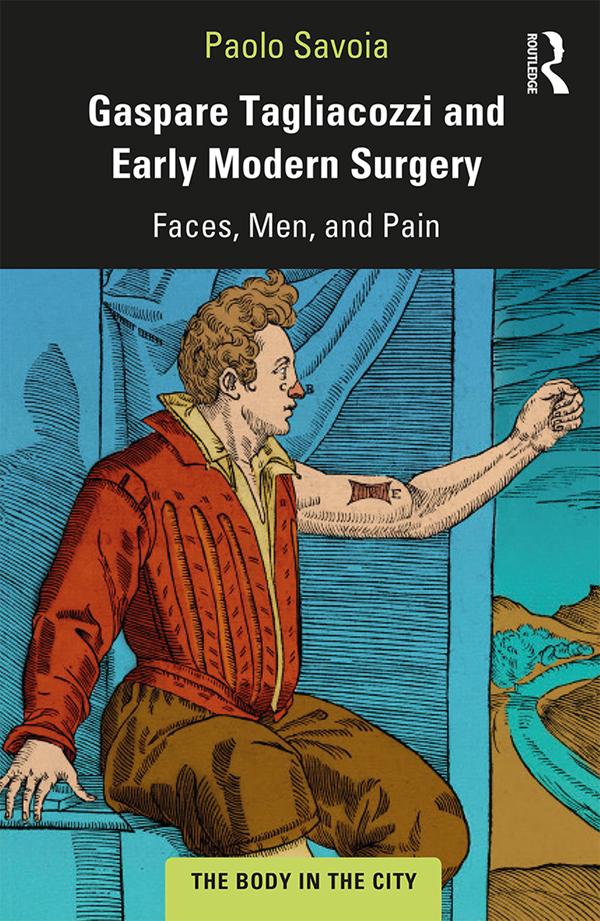
This book uses the work of Bolognese physician and anatomist Gaspare Tagliacozzi to explore the social and cultural history of early modern surgery. It discusses how Italian and European surgeons' attitudes to health and beauty – and how patients' gender – shaped views on the public appearance of the human body.
In 1597, Gaspare Tagliacozzi published a two-volume book on reconstructive surgery of the mutilated parts of the face. Studying Tagliacozzi’s surgery in context corrects widespread views about the birth of plastic surgery. Through a combination of cultural history, microhistory, historical epistemology, and gender history, this book describes the practice and practitioners considered to be at the periphery of the "Scientific Revolution." Historical themes covered include the writing of individual cases, hegemonic and subaltern forms of masculinity, concepts of the natural and the artificial, emotional communities and moral economies of pain, and the historical anthropology of the culture of beauty and the face and its disfigurements.
The book is essential reading for upper-level students, postgraduates, and scholars working on the history of medicine and surgery, the history of the body, and gender and cultural history. It will also appeal to those interested in the history of beauty, urban studies and the Renaissance period more generally.
Pay easily by card, Klarna, Apple Pay or Google Pay. Not happy? You always have a 14-day money-back guarantee. Read more in our terms. If you have any questions, email us at hello@memmo.org.
Memmo makes studying easier – wherever you are in the world. We bring your course books and smart study tools together in one place: summaries, quizzes, podcasts and flashcards. Plus Ted, your study buddy who answers anything you wonder. Over 50,000 students already study here – built to help you learn faster and stress less.