
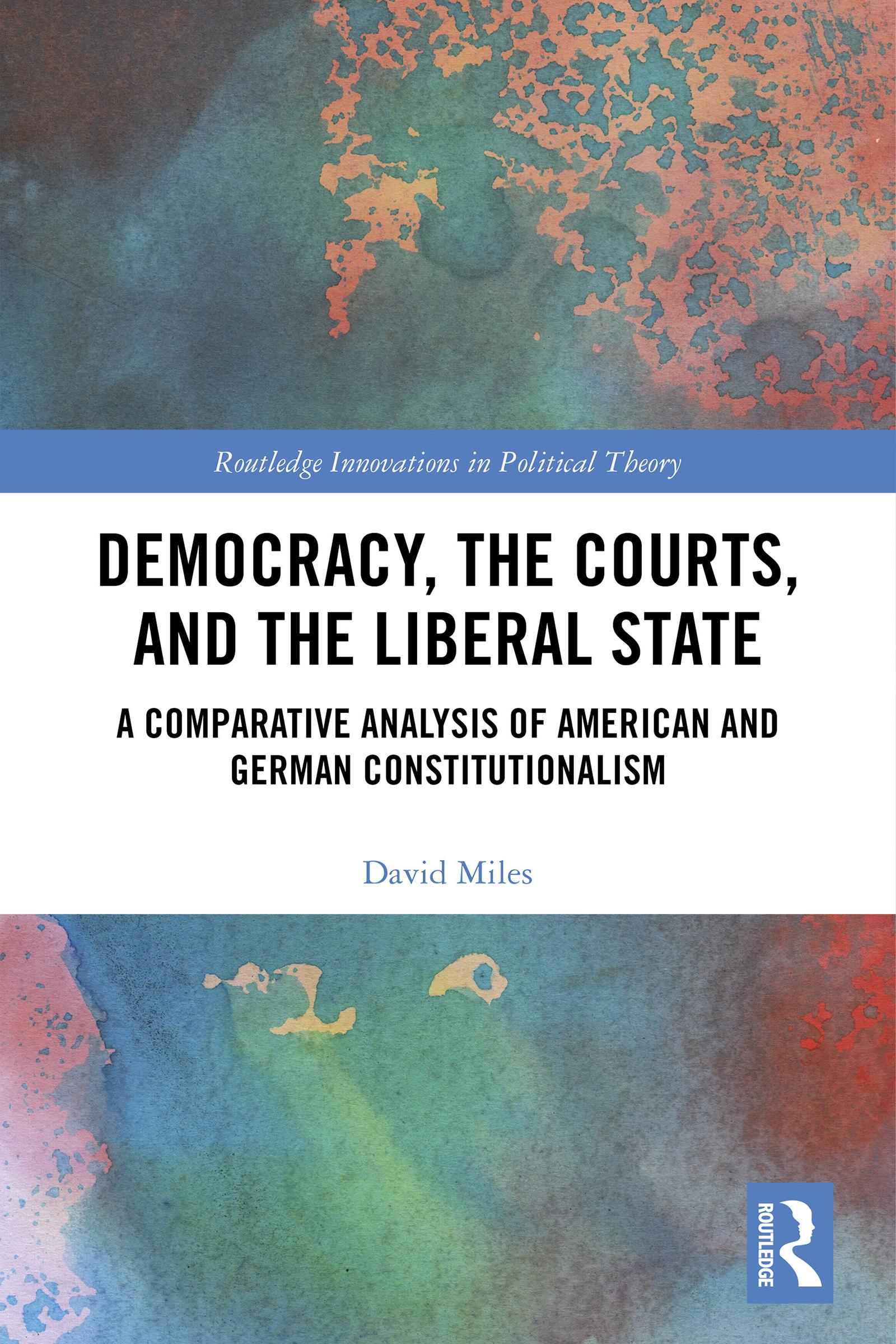
Reformulating a problem of both constitutionalism and liberalism discussed in the works of Ernst-Wolfgang Böckenförde, Hannah Arendt, and Alexis de Tocqueville, the book examines one generally overlooked manifestation of constitutionalism: the role of the courts in shaping democratic politics and the inter-relationship between citizens and state.
Drawing on constitutional history, law, and political theory, David Miles argues that constitutionalism cannot be seen merely as an institutional mechanism to limit government, as it also has a crucial civic dimension upon which the liberal state depends. Utilising the works of Böckenförde, Arendt, and Tocqueville, constitutionalism is conceived in the book as part of a broader system of communal norms which sustains representative democracy and liberalism. Through an analysis of judicial interventions in the electoral processes of the United States and Germany, Miles explores the role of civil society actors in transforming constitutionalism through legal challenges to oligarchical or exclusionary practices. He assesses how, in adjudicating these cases, the US Supreme Court and the German Constitutional Court have mediated the tension between threats to stability and the imperative of democratic renewal.
Democracy, the Courts, and the Liberal State will be of interest to scholars, students, and practitioners interested in comparative politics, political theory, and constitutional law and history.
Pay easily by card, Klarna, Apple Pay or Google Pay. Not happy? You always have a 14-day money-back guarantee. Read more in our terms. If you have any questions, email us at hello@memmo.org.
Memmo makes studying easier – wherever you are in the world. We bring your course books and smart study tools together in one place: summaries, quizzes, podcasts and flashcards. Plus Ted, your study buddy who answers anything you wonder. Over 50,000 students already study here – built to help you learn faster and stress less.