
Many mathematical problems in science and engineering are defined by ordinary or partial differential equations with appropriate initial-boundary conditions. Among the various methods, boundary integral equation method (BIEM) is probably the most effective. It’s main advantage is that it changes a problem from its formulation in terms of unbounded differential operator to one for an integral/integro-differential operator, which makes the problem tractable from the analytical or numerical point of view. Basically, the review/study of the problem is shifted to a boundary (a relatively smaller domain), where it gives rise to integral equations defined over a suitable function space. Integral equations with singular kernels areamong the most important classes in the fields of elasticity, fluid mechanics, electromagnetics and other domains in applied science and engineering. With the advancesin computer technology, numerical simulations have become important tools in science and engineering. Several methods have been developed in numerical analysis for equations in mathematical models of applied sciences.
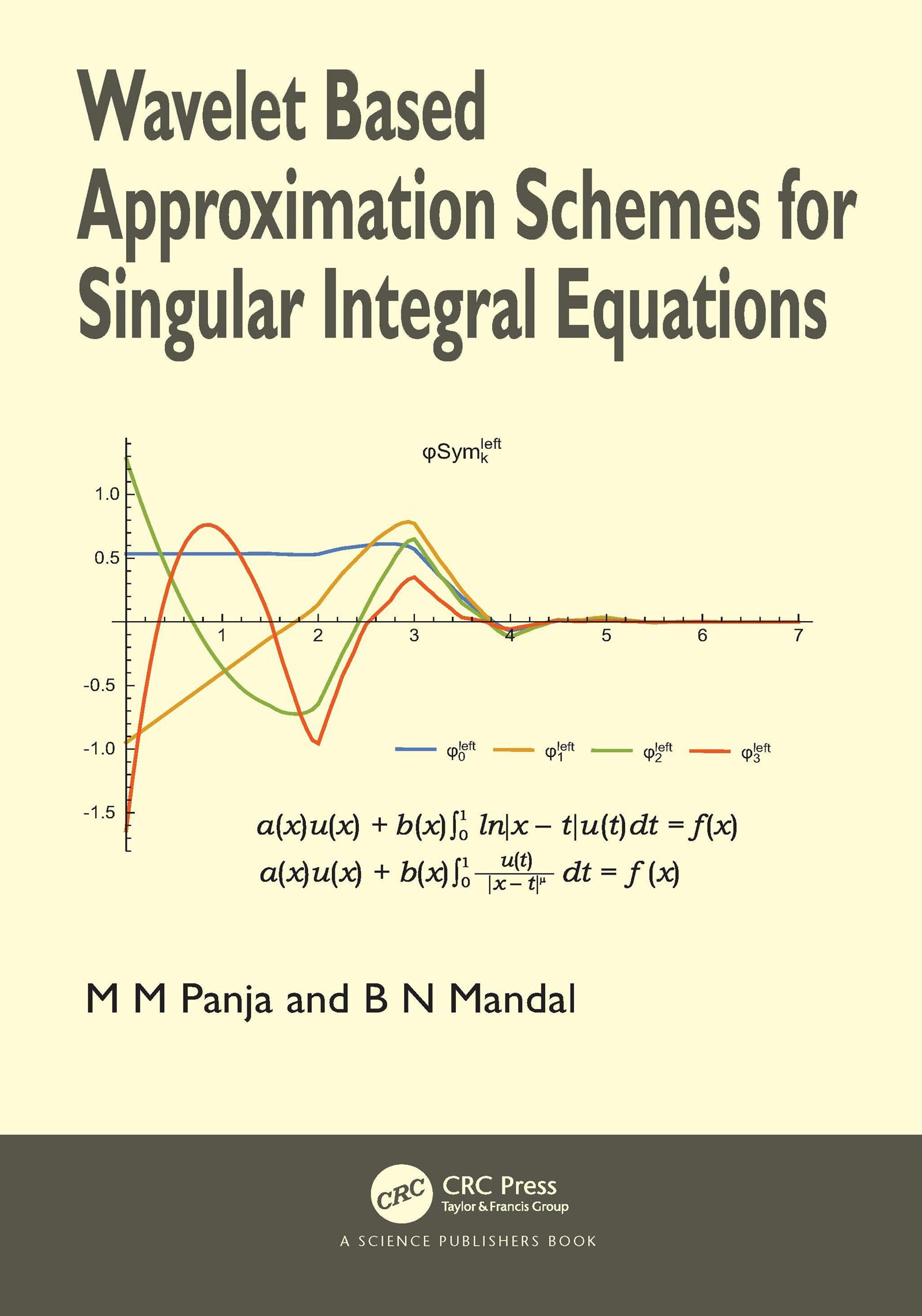
Widely used methods include: Finite Difference Method (FDM), Finite Element Method (FEM), Finite Volume Method (FVM) and Galerkin Method (GM). Unfortunately, none of these are versatile. Each has merits and limitations. For example, the widely used FDM and FEM suffers from difficulties in problem solving when rapid changes appear in singularities. Even with the modern computing machines, analysis of shock-wave or crack propagations in three dimensional solids by the existing classical numerical schemes is challenging (computational time/memory requirements). Therefore, with the availability of faster computing machines, research into the development of new efficient schemes for approximate solutions/numerical simulations is an ongoing parallel activity. Numerical methods based on wavelet basis (multiresolution analysis) may be regarded as a confluence of widely used numerical schemes based on Finite Difference Method, Finite Element Method, Galerkin Method, etc. The objective of this monograph is to deal with numerical techniques to obtain (multiscale) approximate solutions in wavelet basis of different types of integral equations with kernels involving varieties of singularities appearing in the field of elasticity, fluid mechanics, electromagnetics and many other domains in applied science and engineering.
Pay easily by card, Klarna, Apple Pay or Google Pay. Not happy? You always have a 14-day money-back guarantee. Read more in our terms. If you have any questions, email us at hello@memmo.org.
Memmo makes studying easier – wherever you are in the world. We bring your course books and smart study tools together in one place: summaries, quizzes, podcasts and flashcards. Plus Ted, your study buddy who answers anything you wonder. Over 75,000 students already study here – built to help you learn faster and stress less.