
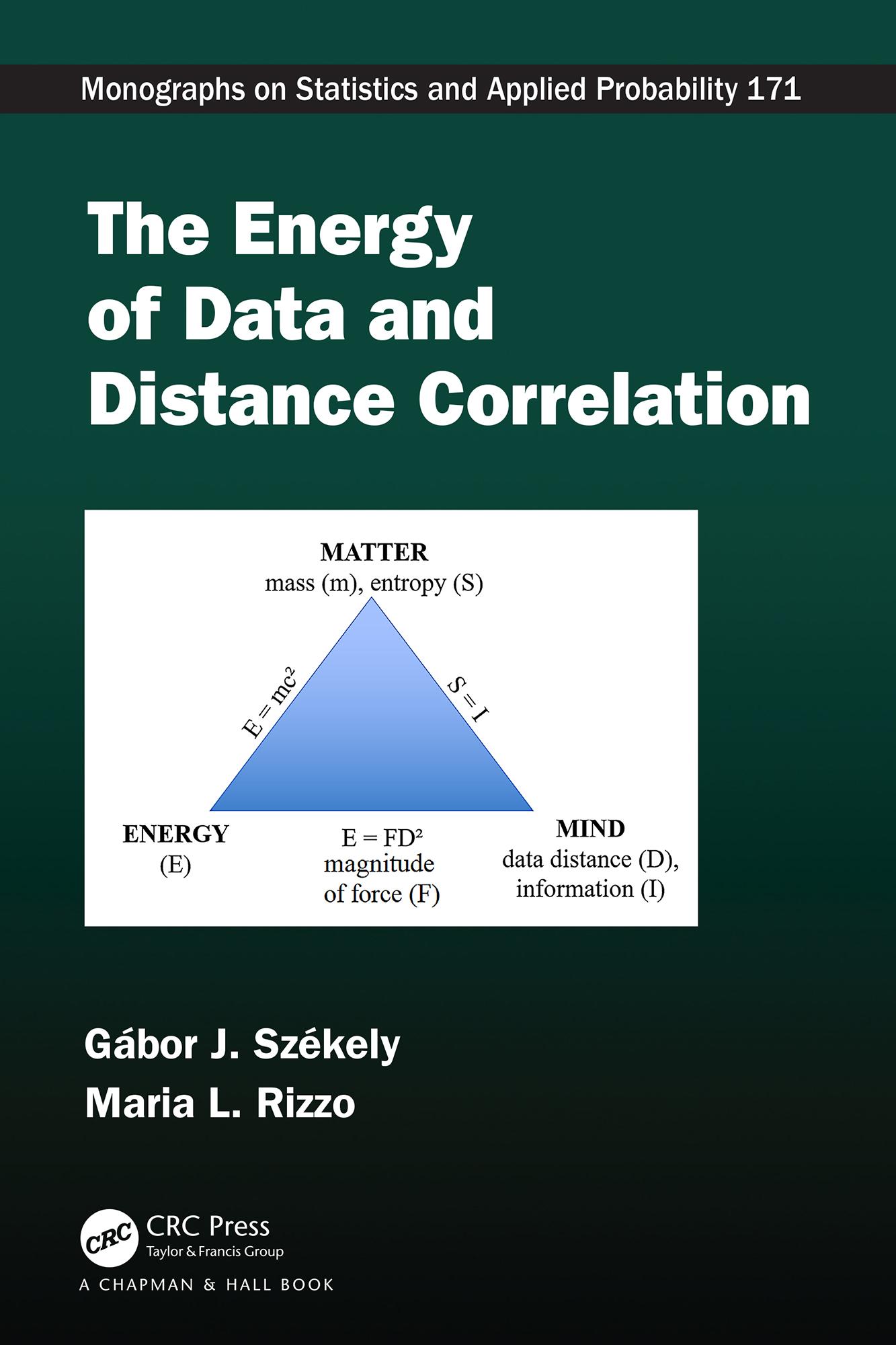
Energy distance is a statistical distance between the distributions of random vectors, which characterizes equality of distributions. The name energy derives from Newton's gravitational potential energy, and there is an elegant relation to the notion of potential energy between statistical observations. Energy statistics are functions of distances between statistical observations in metric spaces. The authors hope this book will spark the interest of most statisticians who so far have not explored E-statistics and would like to apply these new methods using R. The Energy of Data and Distance Correlation is intended for teachers and students looking for dedicated material on energy statistics, but can serve as a supplement to a wide range of courses and areas, such as Monte Carlo methods, U-statistics or V-statistics, measures of multivariate dependence, goodness-of-fit tests, nonparametric methods and distance based methods.
•E-statistics provides powerful methods to deal with problems in multivariate inference and analysis.
•Methods are implemented in R, and readers can immediately apply them using the freely available energy package for R.
•The proposed book will provide an overview of the existing state-of-the-art in development of energy statistics and an overview of applications.
•Background and literature review is valuable for anyone considering further research or application in energy statistics.
Pay easily by card, Klarna, Apple Pay or Google Pay. Not happy? You always have a 14-day money-back guarantee. Read more in our terms. If you have any questions, email us at hello@memmo.org.
Memmo makes studying easier – wherever you are in the world. We bring your course books and smart study tools together in one place: summaries, quizzes, podcasts and flashcards. Plus Ted, your study buddy who answers anything you wonder. Over 75,000 students already study here – built to help you learn faster and stress less.