
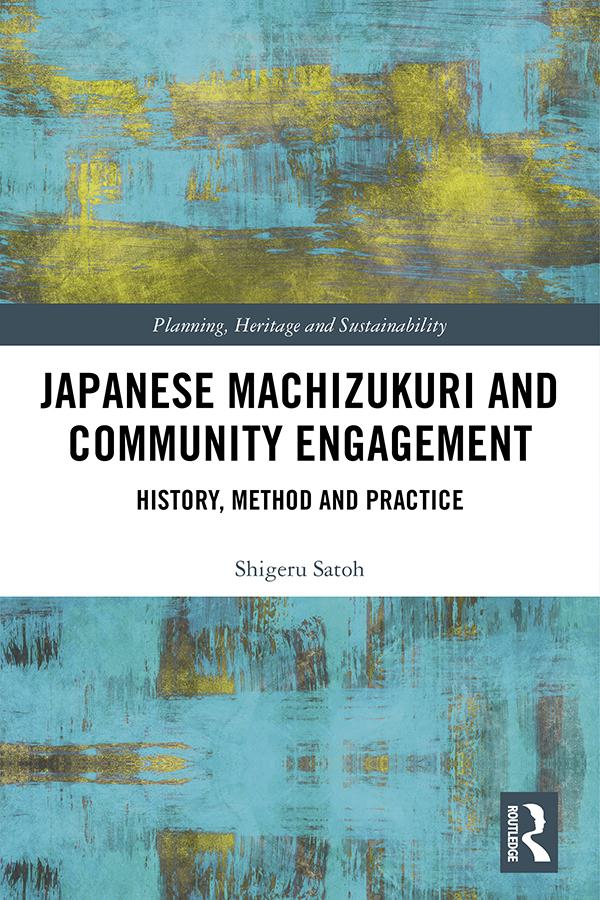
Over the past few decades, Japan has faced severe earthquake disasters, an increasing aging population, declining birth rates, and widening social disparities. These issues have served to highlight gaps left by top-down governance approaches and the urgent need to create resilient societies using more traditional models.
Japanese “machizukuri” has developed to become an exceptional example of bottom-up creative approaches based on collective action and use of local resources. Since its evolution in the 1960s, machizukuri has come to define diverse and creative community-driven management models, by which local communities are enabled to actively tackle problem-solving.
Including contributions from experts directly engaged in the process, this book explores the original development of machizukuri in Japan, its diffusion through East Asia and the positive outcomes of this transfer. Combining theoretical explanations with practical case studies, from pre-disaster planning in Tokyo, to the revitalization of historic towns and rural areas around Japan, the book looks at specific solutions, tools, and links between academics, communities, organizations, governmental bodies, and the private sector. It will appeal to researchers in planning, community engagement, architecture, urban design, and sustainable development.
Pay easily by card, Klarna, Apple Pay or Google Pay. Not happy? You always have a 14-day money-back guarantee. Read more in our terms. If you have any questions, email us at hello@memmo.org.
Memmo makes studying easier – wherever you are in the world. We bring your course books and smart study tools together in one place: summaries, quizzes, podcasts and flashcards. Plus Ted, your study buddy who answers anything you wonder. Over 50,000 students already study here – built to help you learn faster and stress less.