
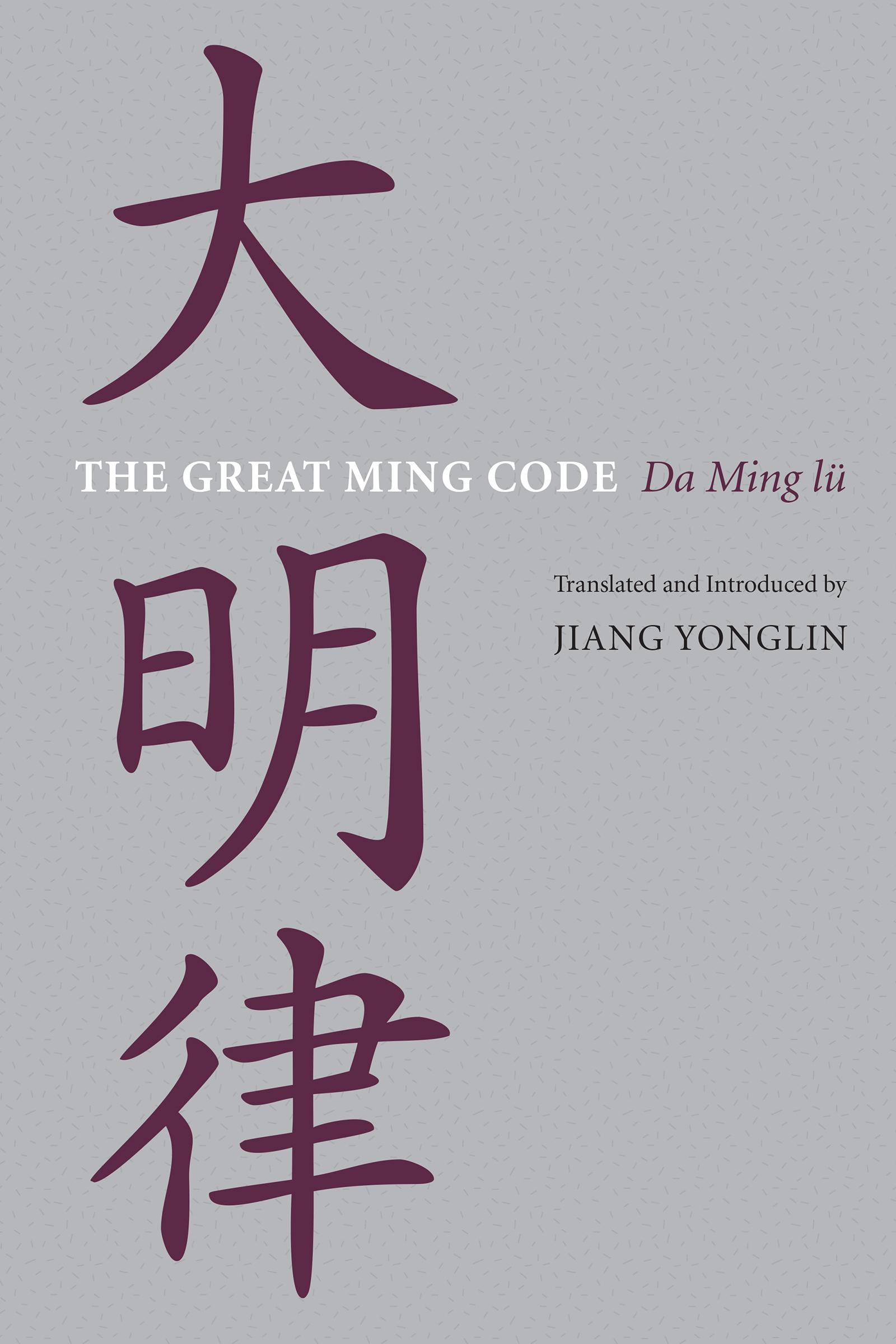
Imperial China’s dynastic legal codes provide a wealth of information for historians, social scientists, and scholars of comparative law and of literary, cultural, and legal history. Until now, only the Tang (618–907 C.E.) and Qing (1644–1911 C.E.) codes have been available in English translation. The present book is the first English translation of The Great Ming Code (Da Ming lu), which reached its final form in 1397. The translation is preceded by an introductory essay that places the Code in historical context, explores its codification process, and examines its structure and contents. A glossary of Chinese terms is also provided.
One of the most important law codes in Chinese history, The Great Ming Code represents a break with the past, following the alien-ruled Yuan (Mongol) dynasty, and the flourishing of culture under the Ming, the last great Han-ruled dynasty. It was also a model for the Qing code, which followed it, and is a fundamental source for understanding Chinese society and culture. The Code regulated all the perceived major aspects of social affairs, aiming at the harmony of political, economic, military, familial, ritual, international, and legal relations in the empire and cosmic relations in the universe. The all-encompassing nature of the Code makes it an encyclopedic document, providing rich materials on Ming history. Because of the pervasiveness of legal proceedings in the culture generally, the Code has relevance far beyond the specialized realm of Chinese legal studies. The basic value system and social norms that the Code imposed became so thoroughly ingrained in Chinese society that the Manchus, who conquered China and established the Qing dynasty, chose to continue the Code in force with only minor changes.
The Code made a considerable impact on the legal cultures of other East Asian countries: Yi dynasty Korea, Le dynasty Vietnam, and late Tokugawa and early Meiji Japan. Examining why and how some rules in the Code were adopted and others rejected in these countries will certainly enhance our understanding of the shared culture and indigenous identities in East Asia.
The open access publication of this book was made possible by a grant from the James P. Geiss and Margaret Y. Hsu Foundation.
Pay easily by card, Klarna, Apple Pay or Google Pay. Not happy? You always have a 14-day money-back guarantee. Read more in our terms. If you have any questions, email us at hello@memmo.org.
Memmo makes studying easier – wherever you are in the world. We bring your course books and smart study tools together in one place: summaries, quizzes, podcasts and flashcards. Plus Ted, your study buddy who answers anything you wonder. Over 50,000 students already study here – built to help you learn faster and stress less.