
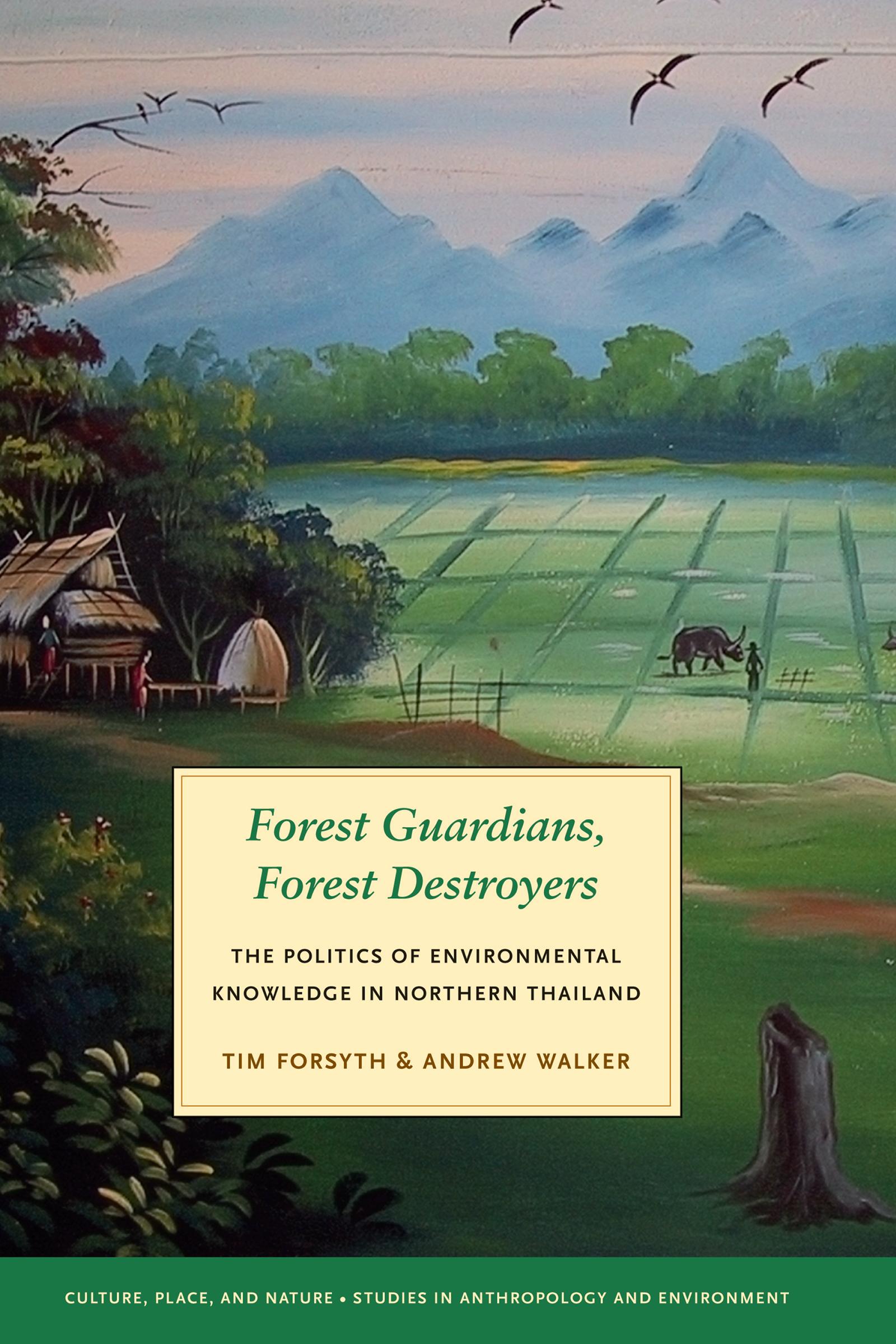
In this far-reaching examination of environmental problems and politics in northern Thailand, Tim Forsyth and Andrew Walker analyze deforestation, water supply, soil erosion, use of agrochemicals, and biodiversity in order to challenge popularly held notions of environmental crisis. They argue that such crises have been used to support political objectives of state expansion and control in the uplands. They have also been used to justify the alternative directions advocated by an array of NGOs.
In official and alternative discourses of economic development, the peoples living in Thailand's hill country are typically cast as either guardians or destroyers of forest resources, often depending on their ethnicity. Political and historical factors have created a simplistic, misleading, and often scientifically inaccurate environmental narrative: Hmong farmers, for example, are thought to exhibit environmentally destructive practices, whereas the Karen are seen as linked to and protective of their ancestral home. Forsyth and Walker reveal a much more complex relationship of hill farmers to the land, to other ethnic groups, and to the state. They conclude that current explanations fail to address the real causes of environmental problems and unnecessarily restrict the livelihoods of local people.
The authors' critical assessment of simplistic environmental narratives, as well as their suggestions for finding solutions, will be valuable in international policy discussions about environmental issues in rapidly developing countries. Moreover, their redefinition of northern Thailand's environmental problems, and their analysis of how political influences have reinforced inappropriate policies, demonstrate new ways of analyzing how environmental science and knowledge are important arenas for political control.
This book makes valuable contributions to Thai studies and more generally to the fields of environmental science, ecology, geography, anthropology, and political science, as well as to policy making and resource management in the developing world.
Pay easily by card, Klarna, Apple Pay or Google Pay. Not happy? You always have a 14-day money-back guarantee. Read more in our terms. If you have any questions, email us at hello@memmo.org.
Memmo makes studying easier – wherever you are in the world. We bring your course books and smart study tools together in one place: summaries, quizzes, podcasts and flashcards. Plus Ted, your study buddy who answers anything you wonder. Over 50,000 students already study here – built to help you learn faster and stress less.