
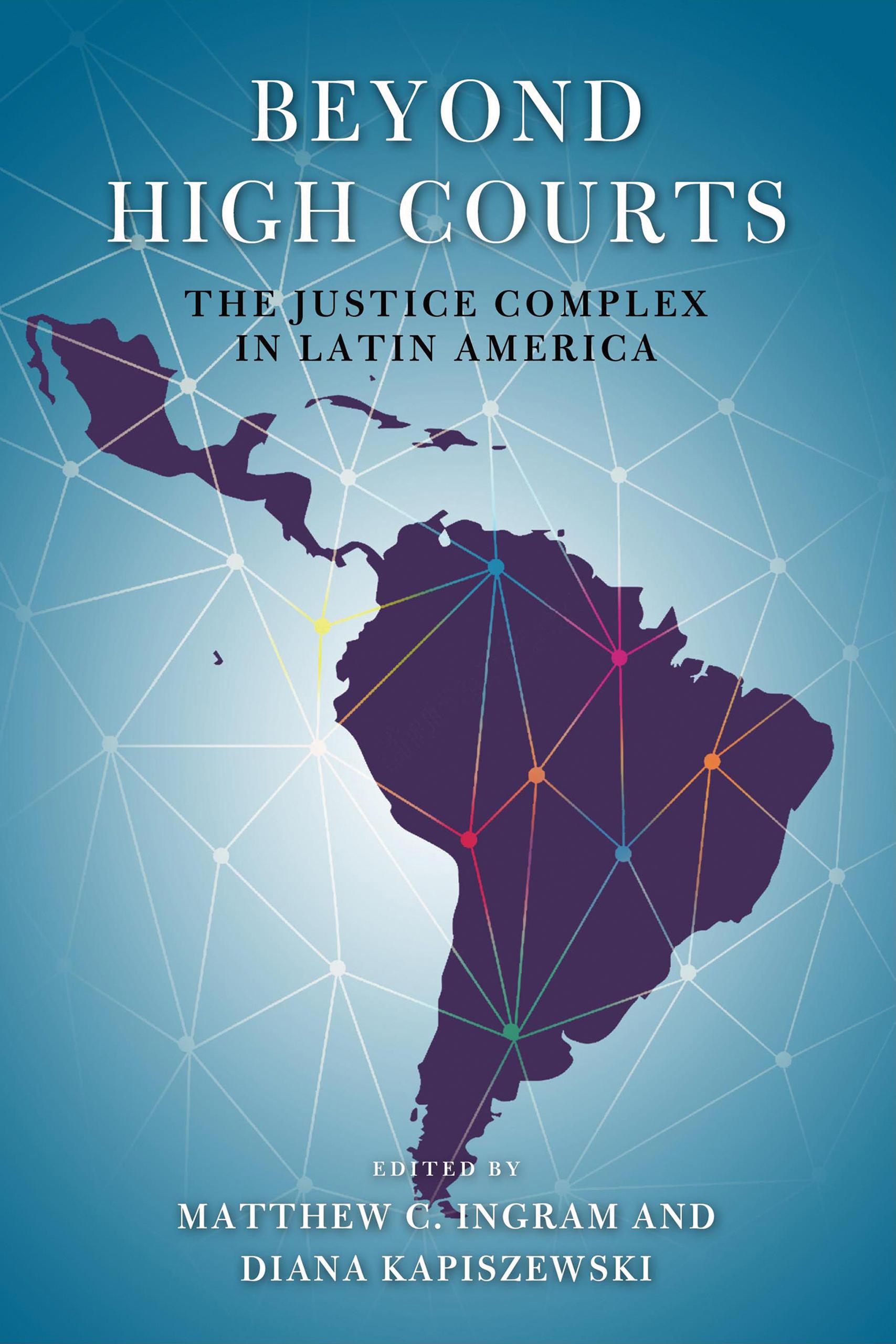
Beyond High Courts: The Justice Complex in Latin America is a much-needed volume that will make a significant contribution to the growing fields of comparative law and politics and Latin American legal institutions. The book moves these research agendas beyond the study of high courts by offering theoretically and conceptually rich empirical analyses of a set of critical supranational, national, and subnational justice sector institutions that are generally neglected in the literature. The chapters examine the region’s large federal systems (Argentina, Brazil, and Mexico), courts in Chile and Venezuela, and the main supranational tribunal in the region, the Inter-American Court of Human Rights. Aimed at students of comparative legal institutions while simultaneously offering lessons for practitioners charged with designing such institutions, the volume advances our understanding of the design of justice institutions, how their form and function change over time, what causes those changes, and what consequences they have. The volume also pays close attention to how justice institutions function as a system, exploring institutional interactions across branches and among levels of government (subnational, national, supranational) and analyzing how they help to shape, and are shaped by, politics and law. Incorporating the institutions examined in the volume into the literature on comparative legal institutions deepens our understanding of justice systems and how their component institutions can both bolster and compromise democracy and the rule of law.
Contributors: Matthew C. Ingram, Diana Kapiszewski, Azul A. Aguiar-Aguilar, Ernani Carvalho, Natália Leitão, Catalina Smulovitz, John Seth Alexander, Robert Nyenhuis, Sídia Maria Porto Lima, José Mário Wanderley Gomes Neto, Danilo Pacheco Fernandes, Louis Dantas de Andrade, Mary L. Volcansek, and Martin Shapiro.
Pay easily by card, Klarna, Apple Pay or Google Pay. Not happy? You always have a 14-day money-back guarantee. Read more in our terms. If you have any questions, email us at hello@memmo.org.
Memmo makes studying easier – wherever you are in the world. We bring your course books and smart study tools together in one place: summaries, quizzes, podcasts and flashcards. Plus Ted, your study buddy who answers anything you wonder. Over 50,000 students already study here – built to help you learn faster and stress less.