
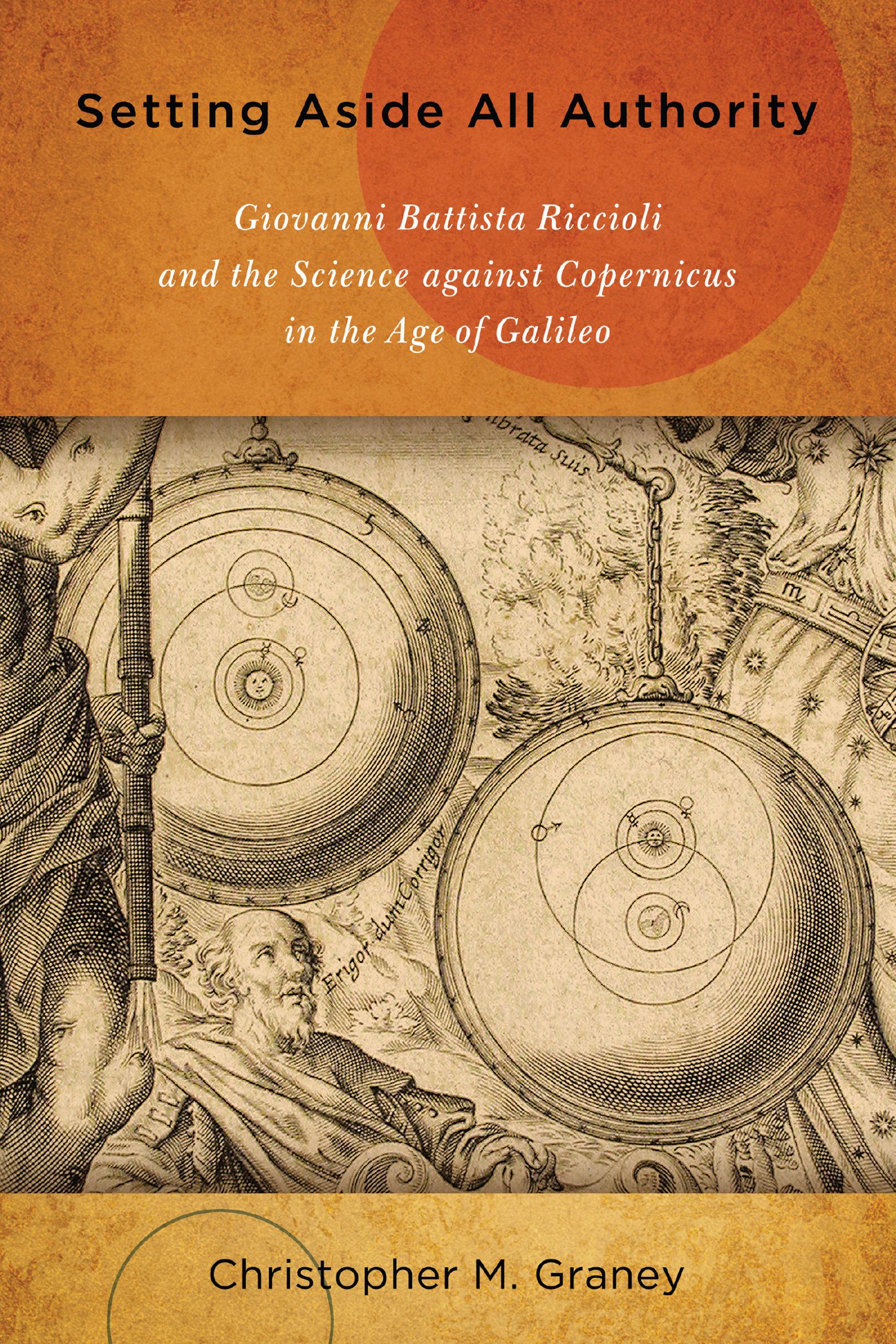
Setting Aside All Authority is an important account and analysis of seventeenth-century scientific arguments against the Copernican system. Christopher M. Graney challenges the long-standing ideas that opponents of the heliocentric ideas of Copernicus and Galileo were primarily motivated by religion or devotion to an outdated intellectual tradition, and that they were in continual retreat in the face of telescopic discoveries.
Graney calls on newly translated works by anti-Copernican writers of the time to demonstrate that science, not religion, played an important, and arguably predominant, role in the opposition to the Copernican system. Anti-Copernicans, building on the work of the Danish astronomer Tycho Brahe, were in fact able to build an increasingly strong scientific case against the heliocentric system at least through the middle of the seventeenth century, several decades after the advent of the telescope. The scientific case reached its apogee, Graney argues, in the 1651 New Almagest of the Italian Jesuit astronomer Giovanni Battista Riccioli, who used detailed telescopic observations of stars to construct a powerful scientific argument against Copernicus. Setting Aside All Authority includes the first English translation of Monsignor Francesco Ingoli’s essay to Galileo (disputing the Copernican system on the eve of the Inquisition’s condemnation of it in 1616) and excerpts from Riccioli's reports regarding his experiments with falling bodies.
Pay easily by card, Klarna, Apple Pay or Google Pay. Not happy? You always have a 14-day money-back guarantee. Read more in our terms. If you have any questions, email us at hello@memmo.org.
Memmo makes studying easier – wherever you are in the world. We bring your course books and smart study tools together in one place: summaries, quizzes, podcasts and flashcards. Plus Ted, your study buddy who answers anything you wonder. Over 50,000 students already study here – built to help you learn faster and stress less.