
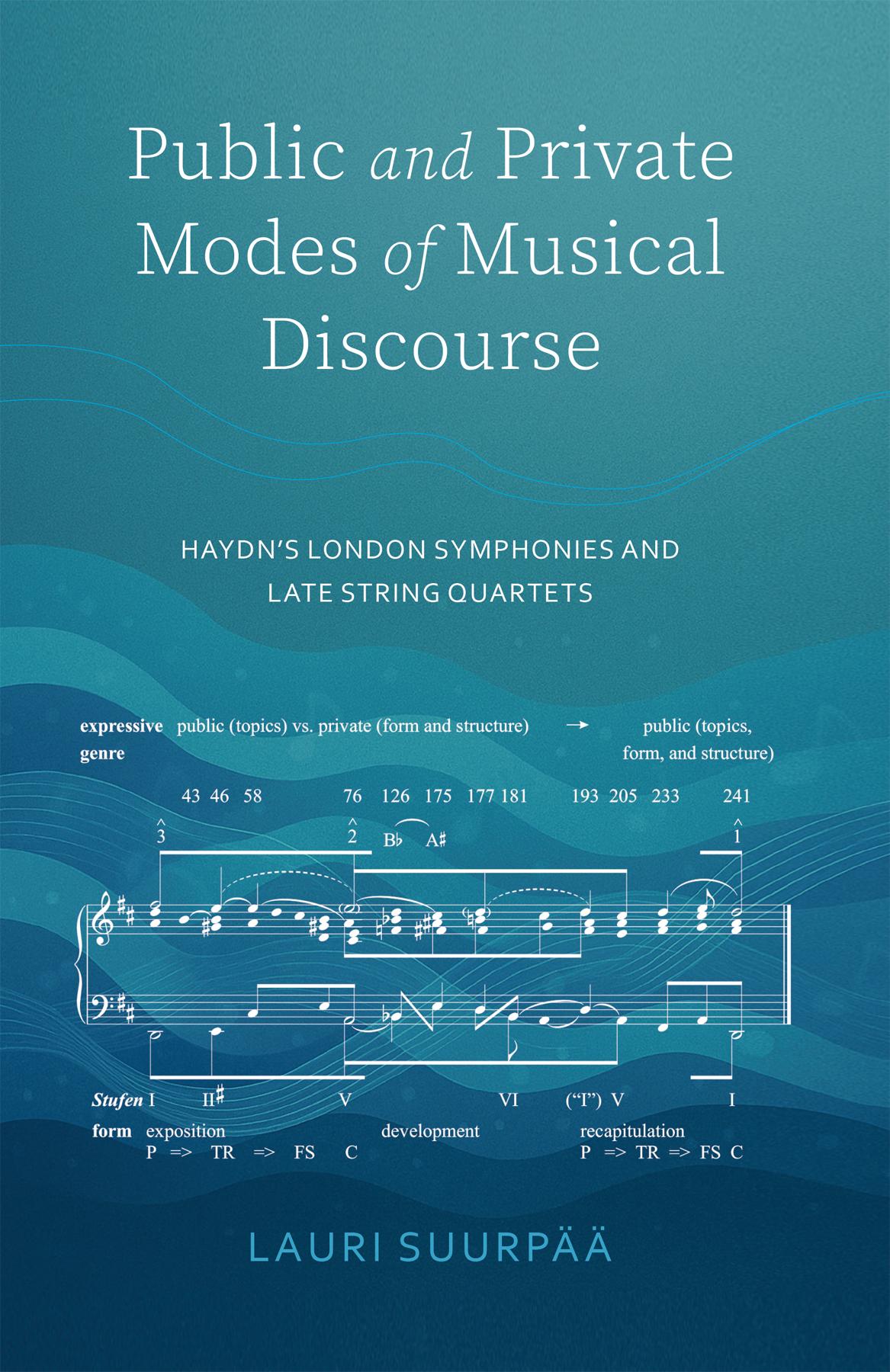
Public and Private Modes of Musical Discourse brings a new contribution to discussions on the difference between the public and private layers of music, which have often centered on issues of stylistic expression such as genre, performance venue, texture, and phrase organization. Symphonies, for example, have historically been seen as public expressions of grandeur with a festive, powerful musical character, while sonatas were associated with the subtler emotions of chamber music and private audiences.
Author Lauri Suurpää offers an alternative starting point for the distinction between these modes, grounding the public-private distinction on structure and expression. Focusing on Joseph Haydn's London symphonies and late string quartets, Suurpää exposes the interplay of details and large-scale narrative and unveils a key aspect of the music—its interactions and dialogues between public and private modes of discourse. In structure, if a musical segment adheres to conventional patterns, it is public; if it deviates from them, it is private. In expression, if a musical topic refers to an object shared by a crowd, such as a fanfare announcing a battle, it is public; if a topic refers to emotions felt by an individual, it is private.
With sonata theory, form-functional theory, Schenkerian analysis, hypermetrical analysis, and approaching musical expression from the perspective of topic theory, layers of structure and expression are peeled back. Public and Private Modes of Musical Discourse offers a valuable new way into how we discuss eighteenth-century music.
Pay easily by card, Klarna, Apple Pay or Google Pay. Not happy? You always have a 14-day money-back guarantee. Read more in our terms. If you have any questions, email us at hello@memmo.org.
Memmo makes studying easier – wherever you are in the world. We bring your course books and smart study tools together in one place: summaries, quizzes, podcasts and flashcards. Plus Ted, your study buddy who answers anything you wonder. Over 50,000 students already study here – built to help you learn faster and stress less.