
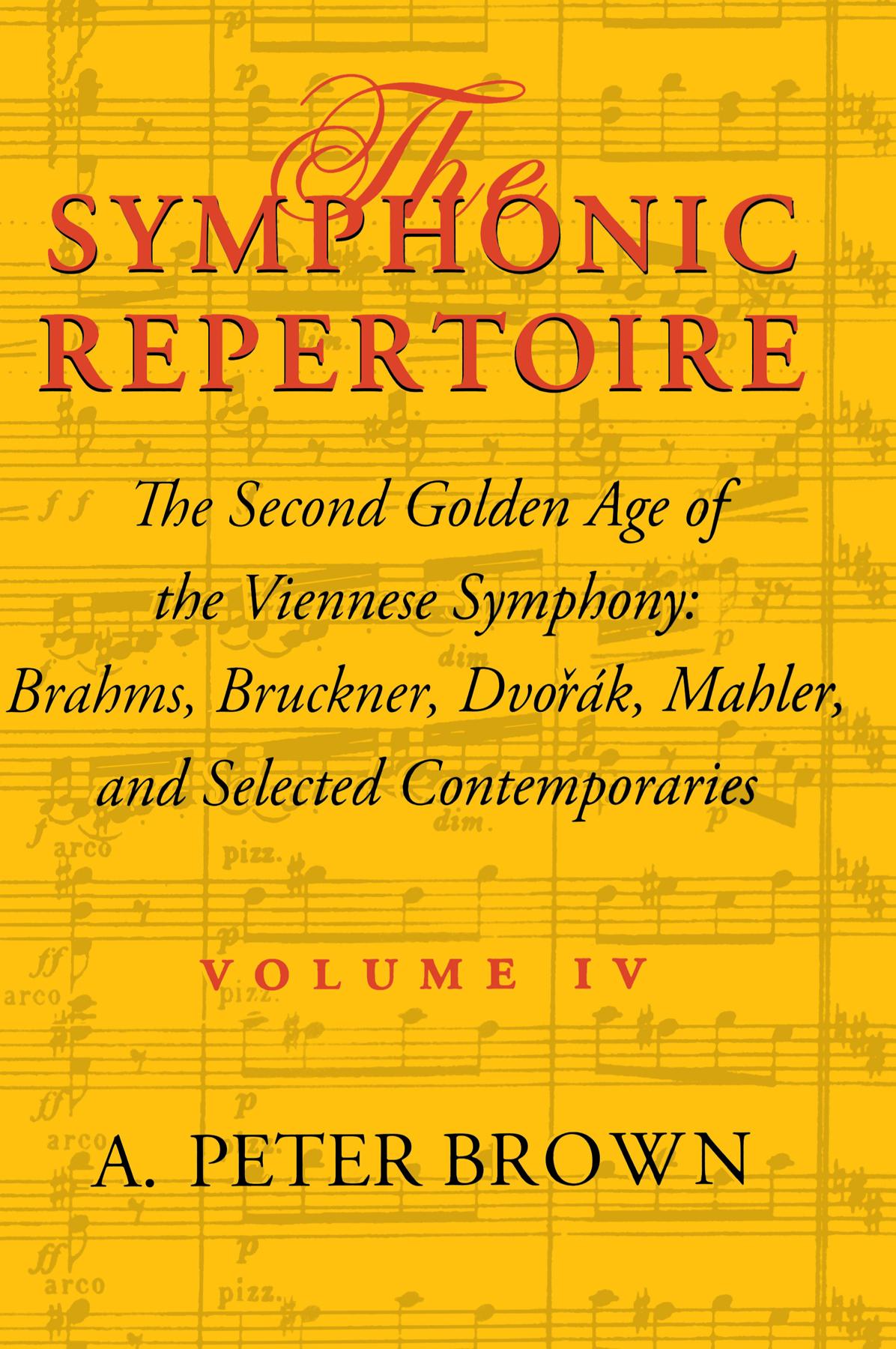
Central to the repertoire of Western art music since the 18th century, the symphony has come to be regarded as one of the ultimate compositional challenges. Surprisingly, heretofore there has been no truly extensive, broad-based treatment of the genre, and the best of the existing studies are now several decades old. In this five-volume series, A. Peter Brown explores the symphony from its 18th-century beginnings to the end of the 20th century. Synthesizing the enormous scholarly literature, Brown presents up-to-date overviews of the status of research, discusses any important former or remaining problems of attribution, illuminates the style of specific works and their contexts, and samples early writings on their reception. The Symphonic Repertoire provides an unmatched compendium of knowledge for the student, teacher, performer, and sophisticated amateur. The series is being launched with two volumes on the Viennese symphony.
Volume IV
The Second Golden Age of the Viennese Symphony
Brahms, Bruckner, Dvorák, Mahler,
and Selected Contemporaries
Although during the mid-19th century the geographic center of the symphony in the Germanic territories moved west and north from Vienna to Leipzig, during the last third of the century it returned to the old Austrian lands with the works of Brahms, Bruckner, Dvorák, and Mahler. After nearly a half century in hibernation, the sleeping Viennese giant awoke to what some viewed as a reincarnation of Beethoven with the first hearing of Brahms's Symphony No. 1, which was premiered at Vienna in December 1876. Even though Bruckner had composed some gigantic symphonies prior to Brahms's first contribution, their full impact was not felt until the composer's complete texts became available after World War II. Although Dvorák was often viewed as a nationalist composer, in his symphonic writing his primary influences were Beethoven, Schubert, and Brahms. For both Bruckner and Mahler, the symphony constituted the heart of their output; for Brahms and Dvorák, it occupied a less central place. Yet for all of them, the key figure of the past remained Beethoven. The symphonies of these four composers, together with the works of Goldmark, Zemlinsky, Schoenberg, Berg, Smetana, Fibich, Janácek, and others are treated in Volume IV, The Second Golden Age of the Viennese Symphony, covering the period from roughly 1860 to 1930.
Pay easily by card, Klarna, Apple Pay or Google Pay. Not happy? You always have a 14-day money-back guarantee. Read more in our terms. If you have any questions, email us at hello@memmo.org.
Memmo makes studying easier – wherever you are in the world. We bring your course books and smart study tools together in one place: summaries, quizzes, podcasts and flashcards. Plus Ted, your study buddy who answers anything you wonder. Over 50,000 students already study here – built to help you learn faster and stress less.