
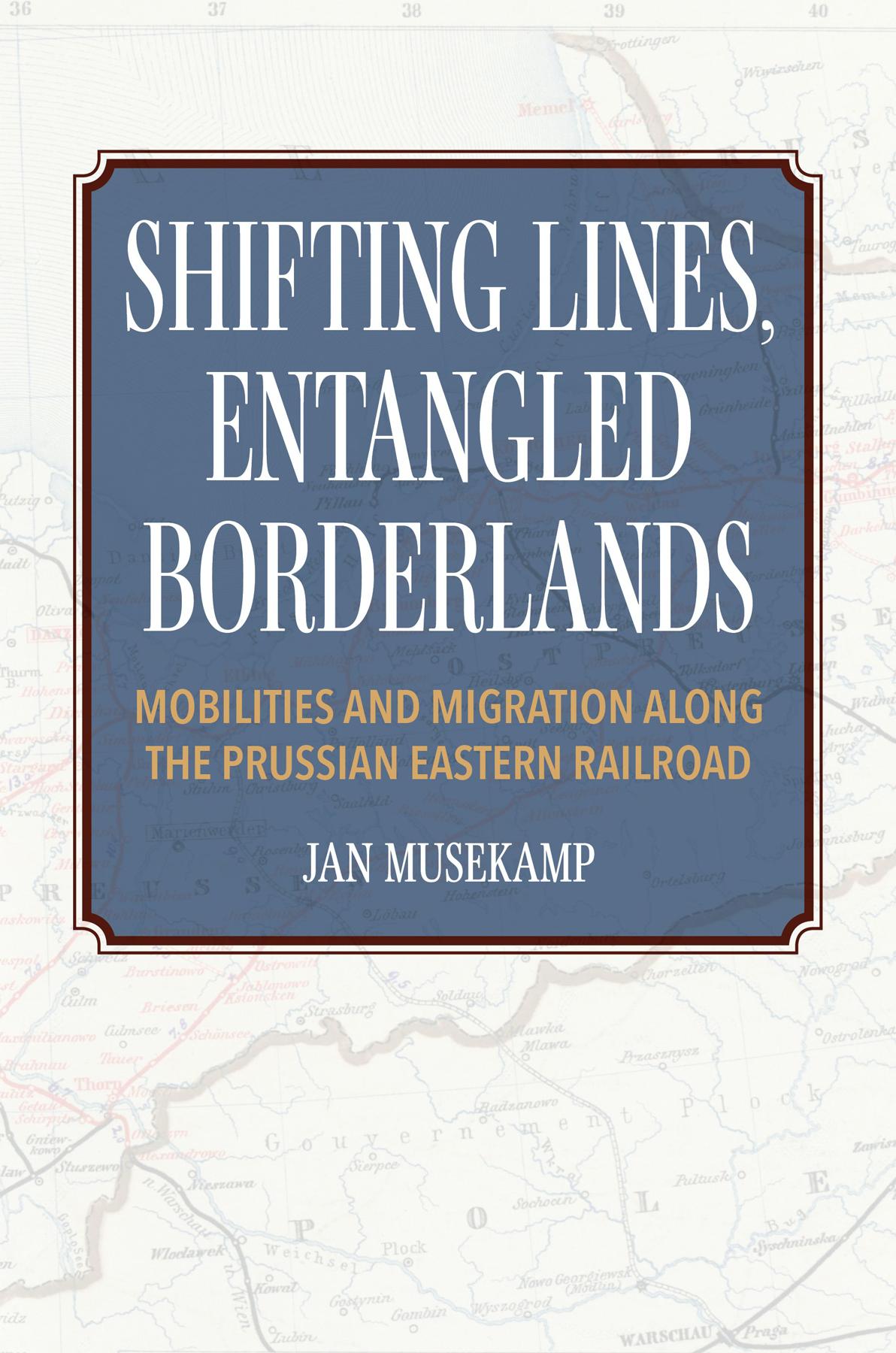
Tracing multiple mobilities, entangled borderlands, microhistory and space, and human and nonhuman actors, Jan Musekamp demonstrates how an inner-Prussian railroad line turned into a transnational force, overcoming borders and connecting Europeans in a time of rising nationalism.
Shifting Lines, Entangled Borderlands investigates the dichotomy between a globalizing world and tighter border control in nineteenth-century Central and Eastern Europe, focusing on the Royal Prussian Eastern Railroad (Ostbahn) between the 1830s and 1930s. The line was initially planned as a major internal modernizing project to connect Prussia's capital of Berlin to East Prussia's provincial capital of Königsberg (today's Kaliningrad). Soon, the Ostbahn connected to the growing Imperial Russian railroad network, thus becoming a backbone of European East–West transportation in trade, tourism, technological exchange, and migration. The First World War temporarily disrupted and reconfigured existing networks, adapting them to new political regimes and borders. However, World War II and its aftermath altered mobility patterns more permanently, dividing not only the Ostbahn tracks but the whole continent for decades to come.
From border towns and major cities to unique structures, such as stations or bridges, this volume analyzes the obvious and not-so-obvious nodes of the Central and Eastern European rail network—and the spaces in between.
Pay easily by card, Klarna, Apple Pay or Google Pay. Not happy? You always have a 14-day money-back guarantee. Read more in our terms. If you have any questions, email us at hello@memmo.org.
Memmo makes studying easier – wherever you are in the world. We bring your course books and smart study tools together in one place: summaries, quizzes, podcasts and flashcards. Plus Ted, your study buddy who answers anything you wonder. Over 75,000 students already study here – built to help you learn faster and stress less.