
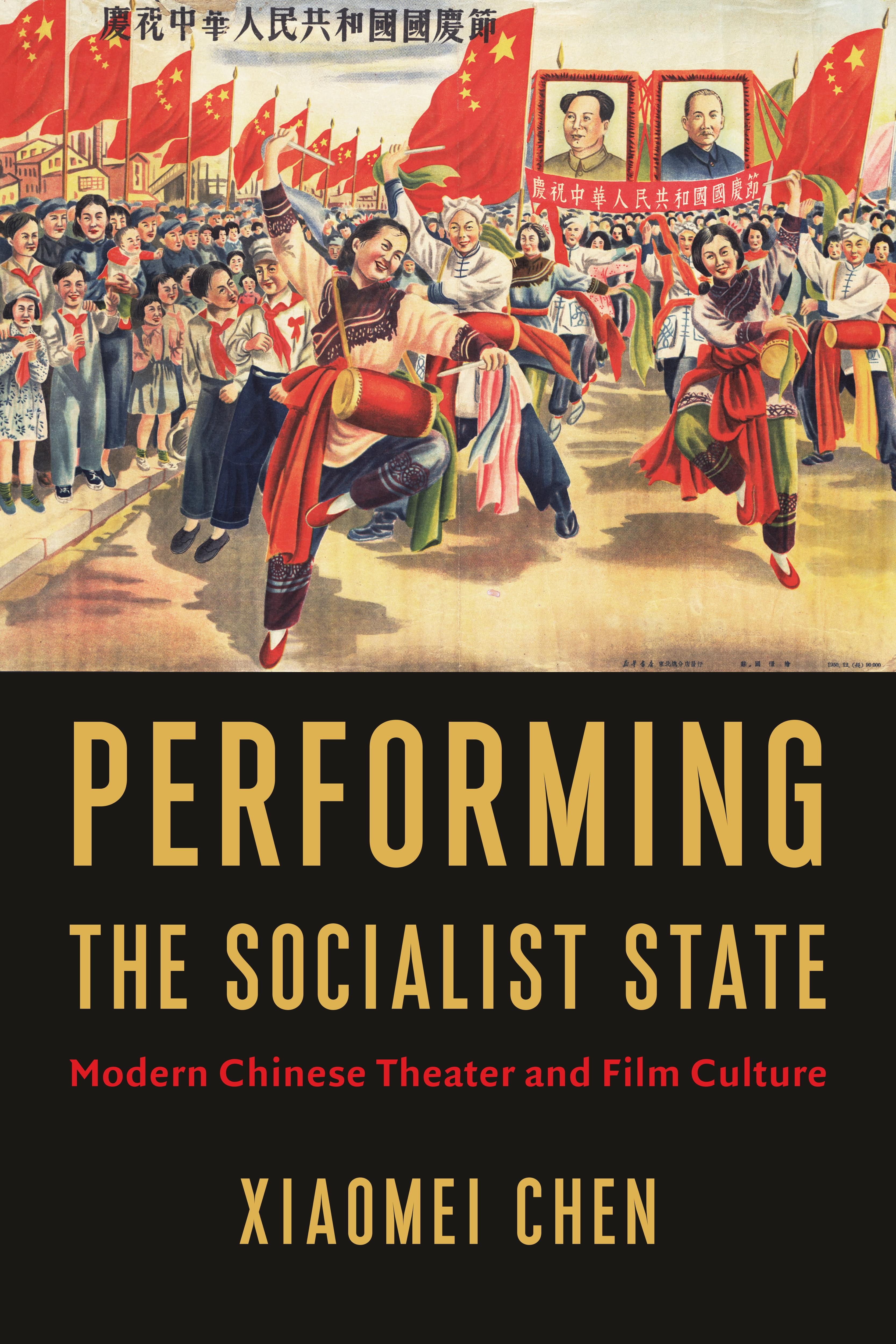
Performing the Socialist State offers an innovative account of the origins, evolution, and legacies of key trends in twentieth-century Chinese theater. Instead of seeing the Republican, high socialist, and postsocialist periods as radically distinct, it identifies key continuities in theatrical practices and shared aspirations for the social role and artistic achievements of performance across eras.
Xiaomei Chen focuses on the long and remarkable careers of three founders of modern Chinese theater and film, Tian Han, Hong Shen, and Ouyang Yuqian, and their legacy, which helped shape theater cultures into the twenty-first century. They introduced Western plays and theories, adapted traditional Chinese operas, and helped develop a tradition of leftist theater in the Republican period that paved the way for the construction of a socialist canon after 1949. Chen investigates how their visions for a free, democratic China fared in the initial years after the founding of the People’s Republic, briefly thriving only to founder as artists had to adapt to the Communist Party’s demand to produce ideologically correct works. Bridging the faith play and “antiparty plays” of the 1950s, the “red classics” of the 1960s, and their reincarnations in the postsocialist period, she considers the transformations of the depictions of women, peasants, soldiers, scientists, and revolutionary history in plays, operas, and films and examines how the market economy, collective memories, star culture, social networks, and state sponsorship affected dramatic productions.
Countering the view that state interference stifles artistic imagination, Chen argues that theater professionals have skillfully navigated shifting ruling ideologies to create works that are politically acceptable yet aesthetically ingenious. Emphasizing the power, dynamics, and complexities of Chinese performance cultures, Performing the Socialist State has implications spanning global theater, comparative literature, political and social histories, and Chinese cultural studies.
Pay easily by card, Klarna, Apple Pay or Google Pay. Not happy? You always have a 14-day money-back guarantee. Read more in our terms. If you have any questions, email us at hello@memmo.org.
Memmo makes studying easier – wherever you are in the world. We bring your course books and smart study tools together in one place: summaries, quizzes, podcasts and flashcards. Plus Ted, your study buddy who answers anything you wonder. Over 75,000 students already study here – built to help you learn faster and stress less.