
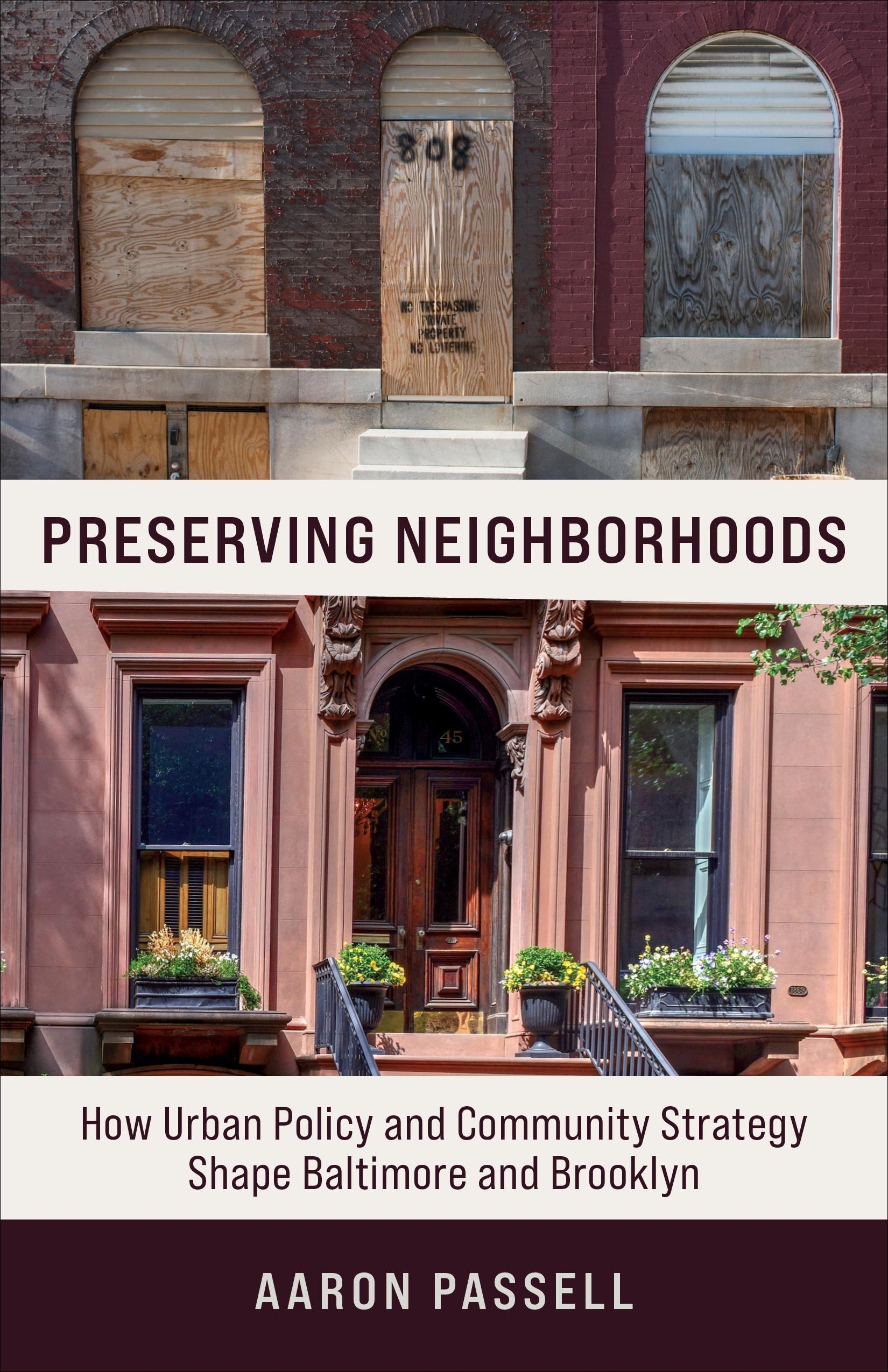
Historic preservation is typically regarded as an elitist practice. In this view, designating a neighborhood as historic is a project by and for affluent residents concerned with aesthetics, not affordability. It leads to gentrification and rising property values for wealthy homeowners, while displacement afflicts longer-term, lower-income residents of the neighborhood, often people of color.
Through rich case studies of Baltimore and Brooklyn, Aaron Passell complicates this story, exploring how community activists and local governments use historic preservation to accelerate or slow down neighborhood change. He argues that this form of regulation is one of the few remaining urban policy interventions that enable communities to exercise some control over the changing built environments of their neighborhoods. In Baltimore, it is part of a primarily top-down strategy for channeling investment into historic neighborhoods, many of them plagued by vacancy and abandonment. In central Brooklyn, neighborhood groups have discovered the utility of landmark district designation as they seek to mitigate rapid change with whatever legal tools they can. The contrast between Baltimore and Brooklyn reveals that the relationship between historic preservation and neighborhood change varies not only from city to city, but even from neighborhood to neighborhood. In speaking with local activists, Passell finds that historic district designation and enforcement efforts can be a part of neighborhood community building and bottom-up revitalization.
Featuring compelling narrative interviews alongside quantitative data, Preserving Neighborhoods is a nuanced mixed-methods study of an important local-level urban policy and its surprisingly varied consequences.
Pay easily by card, Klarna, Apple Pay or Google Pay. Not happy? You always have a 14-day money-back guarantee. Read more in our terms. If you have any questions, email us at hello@memmo.org.
Memmo makes studying easier – wherever you are in the world. We bring your course books and smart study tools together in one place: summaries, quizzes, podcasts and flashcards. Plus Ted, your study buddy who answers anything you wonder. Over 75,000 students already study here – built to help you learn faster and stress less.