
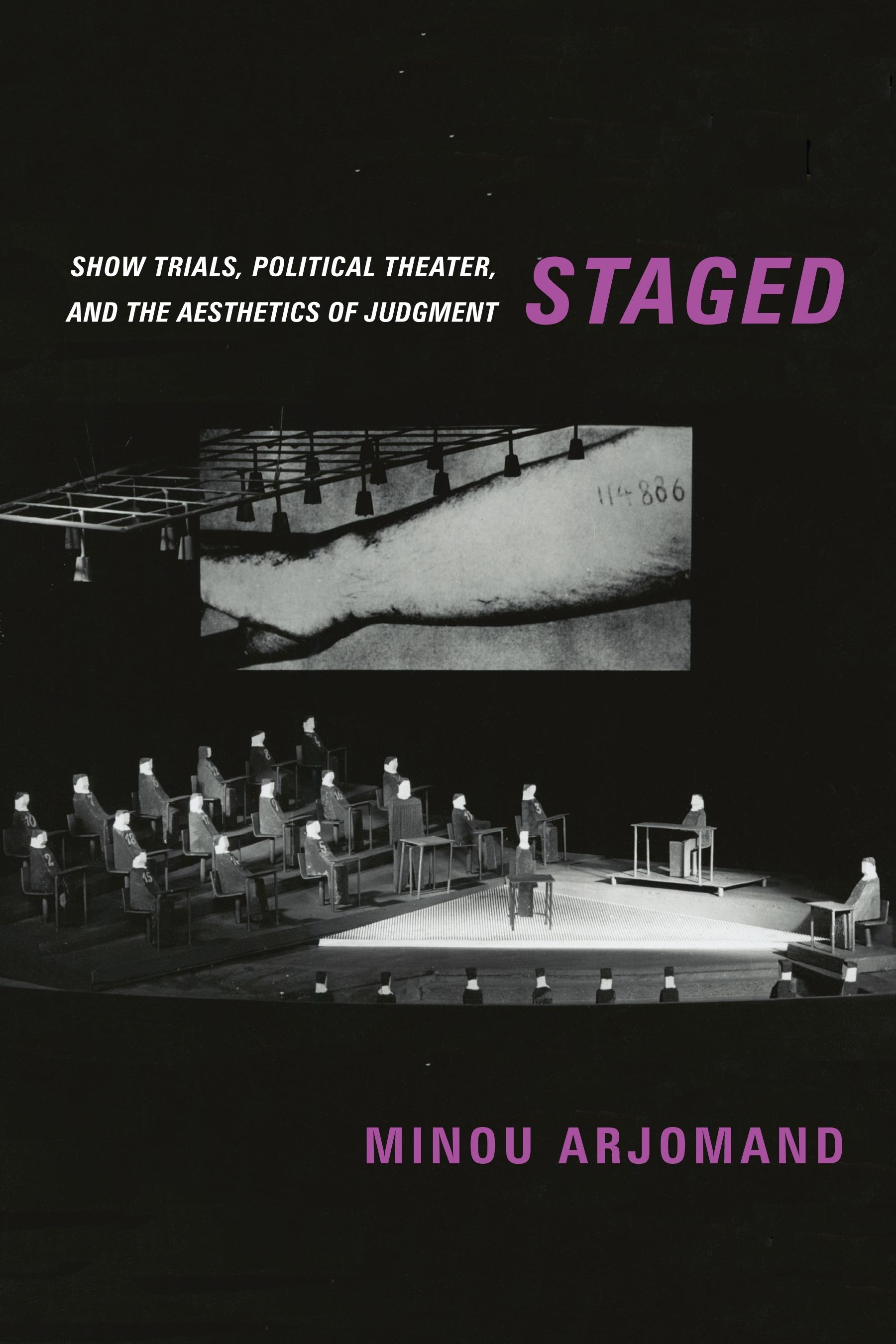
Theater requires artifice, justice demands truth. Are these demands as irreconcilable as the pejorative term “show trials” suggests? After the Second World War, canonical directors and playwrights sought to claim a new public role for theater by restaging the era’s great trials as shows. The Nuremberg trials, the Eichmann trial, and the Auschwitz trials were all performed multiple times, first in courts and then in theaters. Does justice require both courtrooms and stages?
In Staged, Minou Arjomand draws on a rich archive of postwar German and American rehearsals and performances to reveal how theater can become a place for forms of storytelling and judgment that are inadmissible in a court of law but indispensable for public life. She unveils the affinities between dramatists like Bertolt Brecht, Erwin Piscator, and Peter Weiss and philosophers such as Hannah Arendt and Walter Benjamin, showing how they responded to the rise of fascism with a new politics of performance. Linking performance with theories of aesthetics, history, and politics, Arjomand argues that it is not subject matter that makes theater political but rather the act of judging a performance in the company of others. Staged weaves together theater history and political philosophy into a powerful and timely case for the importance of theaters as public institutions.
Pay easily by card, Klarna, Apple Pay or Google Pay. Not happy? You always have a 14-day money-back guarantee. Read more in our terms. If you have any questions, email us at hello@memmo.org.
Memmo makes studying easier – wherever you are in the world. We bring your course books and smart study tools together in one place: summaries, quizzes, podcasts and flashcards. Plus Ted, your study buddy who answers anything you wonder. Over 75,000 students already study here – built to help you learn faster and stress less.