
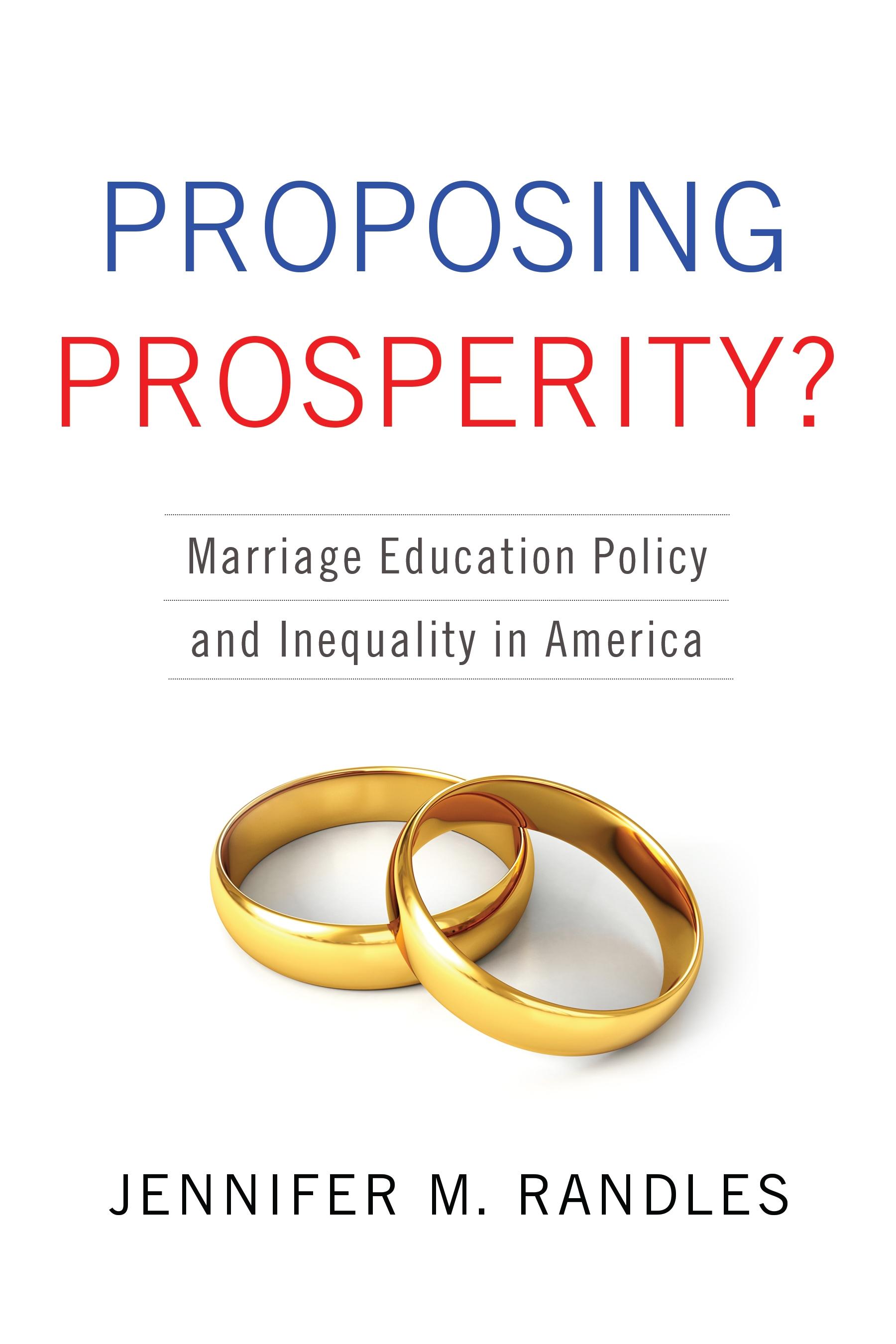
"Fragile families"—unmarried parents who struggle emotionally and financially—are one of the primary targets of the Healthy Marriage Initiative, a federal policy that has funded marriage education programs in nearly every state. These programs, which encourage marriage by teaching relationship skills, are predicated on the hope that married couples can provide a more emotionally and financially stable home for their children.
Healthy marriage policy promotes a pro-marriage culture in which two-parent married families are considered the healthiest. It also assumes that marriage can be a socioeconomic survival mechanism for low-income families, and an engine of upward mobility.
Through interviews with couples and her own observations and participation in marriage education courses, Jennifer M. Randles challenges these assumptions and critically examines the effects of such classes on participants. She takes the reader inside healthy marriage classrooms to reveal how their curricula are reflections of broader issues of culture, gender, governance, and social inequality. In analyzing the implementation of healthy marriage policy, Randles questions whether it should target individual behavior or the social and economic context of that behavior. The most valuable approach, she concludes, will not be grounded in notions of middle-class marriage culture. Instead, it will reflect the fundamental premise that love and commitment thrive most within the context of social and economic opportunity.
Pay easily by card, Klarna, Apple Pay or Google Pay. Not happy? You always have a 14-day money-back guarantee. Read more in our terms. If you have any questions, email us at hello@memmo.org.
Memmo makes studying easier – wherever you are in the world. We bring your course books and smart study tools together in one place: summaries, quizzes, podcasts and flashcards. Plus Ted, your study buddy who answers anything you wonder. Over 50,000 students already study here – built to help you learn faster and stress less.