
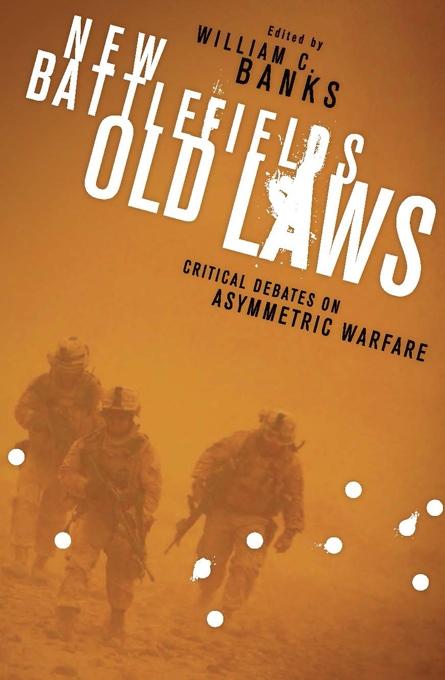
An internationally-recognized authority on constitutional law, national security law, and counterterrorism, William C. Banks believes changing patterns of global conflict are forcing a reexamination of the traditional laws of war. The Hague Rules, the customary laws of war, and the post-1949 law of armed conflict no longer account for nonstate groups waging prolonged campaigns of terrorism—or even more conventional insurgent attacks.
Recognizing that many of today's conflicts are low-intensity, asymmetrical wars fought between disparate military forces, Banks's collection analyzes nonstate armed groups and irregular forces (such as terrorist and insurgent groups, paramilitaries, child soldiers, civilians participating in hostilities, and private military firms) and their challenge to international humanitarian law. Both he and his contributors believe gaps in the laws of war leave modern battlefields largely unregulated, and they fear state parties suffer without guidelines for responding to terrorists and their asymmetrical tactics, such as the targeting of civilians. These gaps also embolden weaker, nonstate combatants to exploit forbidden strategies and violate the laws of war.
Attuned to the contested nature of post-9/11 security and policy, this collection juxtaposes diverse perspectives on existing laws and their application in contemporary conflict. It sets forth a legal definition of new wars, describes the status of new actors, charts the evolution of the twenty-first-century battlefield, and balances humanitarian priorities with military necessity. While the contributors contest each other, they ultimately reestablish the legitimacy of a long-standing legal corpus, and they rehumanize an environment in which the most vulnerable targets, civilian populations, are themselves becoming weapons against conventional power.
Pay easily by card, Klarna, Apple Pay or Google Pay. Not happy? You always have a 14-day money-back guarantee. Read more in our terms. If you have any questions, email us at hello@memmo.org.
Memmo makes studying easier – wherever you are in the world. We bring your course books and smart study tools together in one place: summaries, quizzes, podcasts and flashcards. Plus Ted, your study buddy who answers anything you wonder. Over 50,000 students already study here – built to help you learn faster and stress less.