
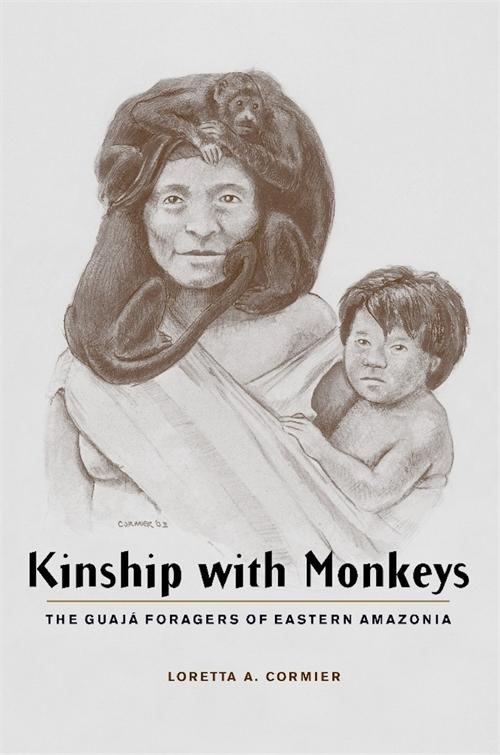
Intrigued by a slide showing a woman breast-feeding a monkey, anthropologist Loretta A. Cormier spent fifteen months living among the Guajá, a foraging people in a remote area of Brazil. The result is this ethnographic study of the extraordinary relationship between the Guajá Indians and monkeys. While monkeys are a key food source for the Guajá, certain pet monkeys have a quasi-human status. Some infant monkeys are adopted and nurtured as human children while others are consumed in accordance with the "symbolic cannibalism" of their belief system.
The apparent contradiction of this predator/protector relationship became the central theme of Cormier's research: How can monkeys be both eaten as food and nurtured as children? Her research reveals that monkeys play a vital role in Guajá society, ecology, economy, and religion. In Guajá animistic beliefs, all forms of plant and animal life—especially monkeys—have souls and are woven into a comprehensive kinship system. Therefore, all consumption can be considered a form of cannibalism.
Cormier sets the stage for this enlightening study by examining the history of the Guajá and the ecological relationships between human and nonhuman primates in Amazonia. She also addresses the importance of monkeys in Guajá ecological adaptation as well as their role in the Guajá kinship system. Cormier then looks at animism and life classification among the Guajá and the role of pets, which provide a context for understanding "symbolic cannibalism" and how the Guajá relate to various forms of life in their natural and supernatural world. The book concludes with a discussion of the implications of ethnoprimatology beyond Amazonia, including Western perceptions of primates.
Pay easily by card, Klarna, Apple Pay or Google Pay. Not happy? You always have a 14-day money-back guarantee. Read more in our terms. If you have any questions, email us at hello@memmo.org.
Memmo makes studying easier – wherever you are in the world. We bring your course books and smart study tools together in one place: summaries, quizzes, podcasts and flashcards. Plus Ted, your study buddy who answers anything you wonder. Over 50,000 students already study here – built to help you learn faster and stress less.