
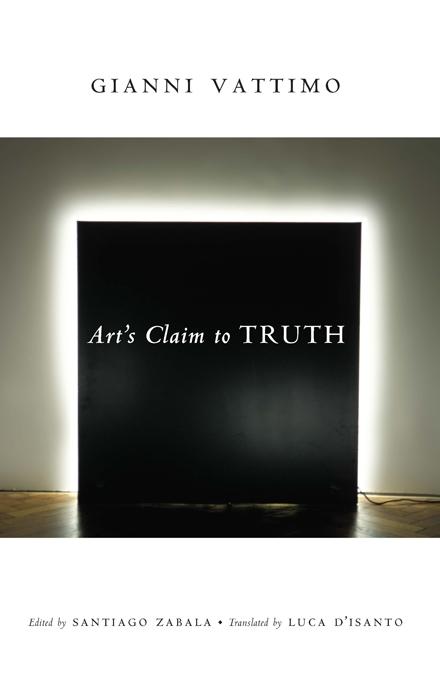
First collected in Italy in 1985, Art's Claim to Truth is considered by many philosophers to be one of Gianni Vattimo's most important works. Newly revised for English readers, the book begins with a challenge to Plato, Aristotle, Kant, and Hegel, who viewed art as a metaphysical aspect of reality rather than a futuristic anticipation of it. Following Martin Heidegger's interpretation of the history of philosophy, Vattimo outlines the existential ontological conditions of aesthetics, paying particular attention to the works of Kandinsky, which reaffirm the ontological implications of art.
Vattimo then builds on Hans-Georg Gadamer's theory of aesthetics and provides an alternative to a rationalistic-positivistic criticism of art. This is the heart of Vattimo's argument, and with it he demonstrates how hermeneutical philosophy reaffirms art's ontological status and makes clear the importance of hermeneutics for aesthetic studies. In the book's final section, Vattimo articulates the consequences of reclaiming the ontological status of aesthetics without its metaphysical implications, holding Aristotle's concept of beauty responsible for the dissolution of metaphysics itself. In its direct engagement with the works of Gadamer, Heidegger, and Luigi Pareyson, Art's Claim to Truth offers a better understanding of the work of Vattimo and a deeper knowledge of ontology, hermeneutics, and the philosophical examination of truth.
Pay easily by card, Klarna, Apple Pay or Google Pay. Not happy? You always have a 14-day money-back guarantee. Read more in our terms. If you have any questions, email us at hello@memmo.org.
Memmo makes studying easier – wherever you are in the world. We bring your course books and smart study tools together in one place: summaries, quizzes, podcasts and flashcards. Plus Ted, your study buddy who answers anything you wonder. Over 50,000 students already study here – built to help you learn faster and stress less.