
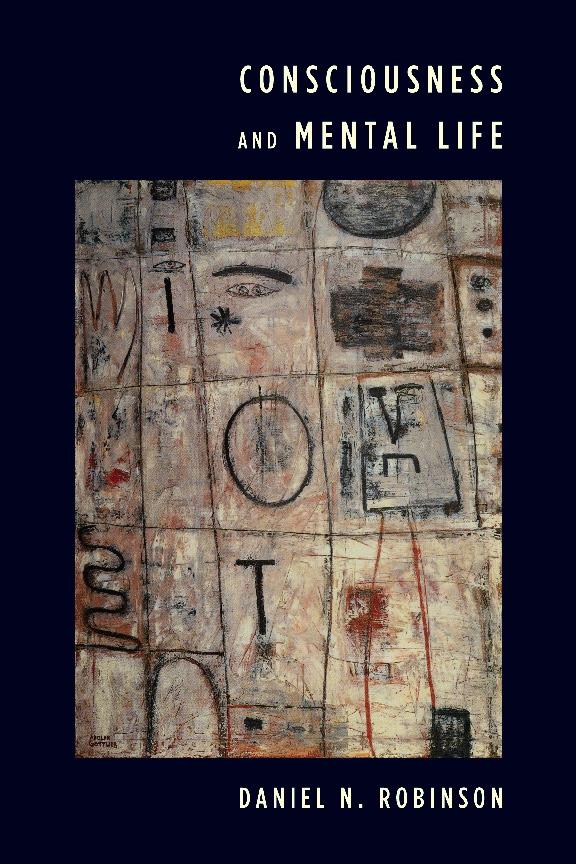
In recent decades, issues that reside at the center of philosophical and psychological inquiry have been absorbed into a scientific framework variously identified as "brain science," "cognitive science," and "cognitive neuroscience." Scholars have heralded this development as revolutionary, but a revolution implies an existing method has been overturned in favor of something new. What long-held theories have been abandoned or significantly modified in light of cognitive neuroscience?
Consciousness and Mental Life questions our present approach to the study of consciousness and the way modern discoveries either mirror or contradict understandings reached in the centuries leading up to our own. Daniel N. Robinson does not wage an attack on the emerging discipline of cognitive science. Rather, he provides the necessary historical context to properly evaluate the relationship between issues of consciousness and neuroscience and their evolution over time.
Robinson begins with Aristotle and the ancient Greeks and continues through to René Descartes, David Hume, William James, Daniel Dennett, John Searle, Richard Rorty, Hilary Putnam, and Derek Parfit. Approaching the issue from both a philosophical and a psychological perspective, Robinson identifies what makes the study of consciousness so problematic and asks whether cognitive neuroscience can truly reveal the origins of mental events, emotions, and preference, or if these occurrences are better understood by studying the whole person, not just the brain. Well-reasoned and thoroughly argued, Consciousness and Mental Life corrects many claims made about the success of brain science and provides a valuable historical context for the study of human consciousness.
Pay easily by card, Klarna, Apple Pay or Google Pay. Not happy? You always have a 14-day money-back guarantee. Read more in our terms. If you have any questions, email us at hello@memmo.org.
Memmo makes studying easier – wherever you are in the world. We bring your course books and smart study tools together in one place: summaries, quizzes, podcasts and flashcards. Plus Ted, your study buddy who answers anything you wonder. Over 50,000 students already study here – built to help you learn faster and stress less.