
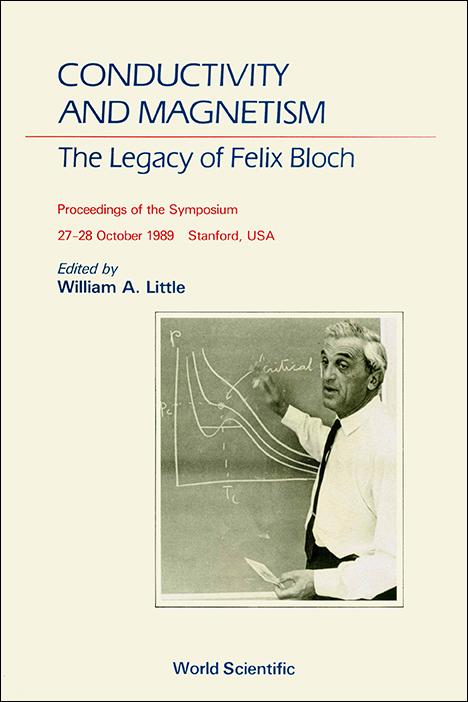
Felix Bloch was one of the foremost scientists of the 20th century. His work on the theory of metals in 1929 laid the cornerstone for the development of semiconductors and his work on magnetism was crucial for the development of a basic understanding of ferromagnetism. Nuclear Magnetic Resonance, which he discovered in 1946, and for which he shared the Nobel Prize with Edward Purcell in 1952, has become the most important spectroscopic tool in Chemistry. The year 1989 marks the sixtieth year since Bloch's paper on the Theory of Metals. This Symposium celebrated the occasion by gathering a group of distinguished scientists who presented overviews of the past, present and future of several major areas of Physics, Chemistry, Engineering, Computer Science, Biology and Medicine, many of which trace their origins to Bloch's influence.
Betala smidigt med kort, Klarna, Apple Pay eller Google Pay. Är du inte nöjd har du alltid 14 dagars ångerrätt. Läs mer i våra villkor. Har du några frågor, mejla oss på hello@memmo.org.
Memmo gör det enklare att plugga – var du än är i världen. Hos oss samlar du kursböcker och smarta studieverktyg på ett och samma ställe: sammanfattningar, quiz, poddar och flashcards. Och så Ted, din studiekompis som svarar på allt du undrar. Över 50 000 studenter pluggar redan här – byggt för att du ska lära dig snabbare och stressa mindre.
Du kanske också gillar
Köp boken0