
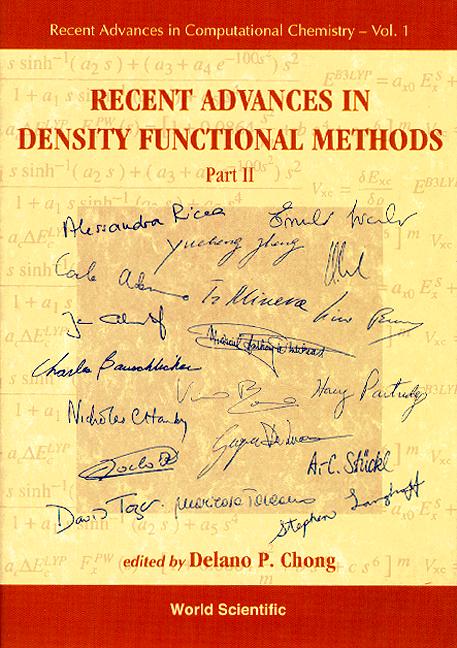
Of all the different areas in computational chemistry, density functional theory (DFT) enjoys the most rapid development. Even at the level of the local density approximation (LDA), which is computationally less demanding, DFT can usually provide better answers than Hartree-Fock formalism for large systems such as clusters and solids. For atoms and molecules, the results from DFT often rival those obtained by ab initio quantum chemistry, partly because larger basis sets can be used. Such encouraging results have in turn stimulated workers to further investigate the formal theory as well as the computational methodology of DFT.This Part II expands on the methodology and applications of DFT. Some of the chapters report on the latest developments (since the publication of Part I in 1995), while others extend the applications to wider range of molecules and their environments. Together, this and other recent review volumes on DFT show that DFT provides an efficient and accurate alternative to traditional quantum chemical methods. Such demonstration should hopefully stimulate frutiful developments in formal theory, better exchange-correlation functionals, and linear scaling methodology.
Betala smidigt med kort, Klarna, Apple Pay eller Google Pay. Är du inte nöjd har du alltid 14 dagars ångerrätt. Läs mer i våra villkor. Har du några frågor, mejla oss på hello@memmo.org.
Memmo gör det enklare att plugga – var du än är i världen. Hos oss samlar du kursböcker och smarta studieverktyg på ett och samma ställe: sammanfattningar, quiz, poddar och flashcards. Och så Ted, din studiekompis som svarar på allt du undrar. Över 50 000 studenter pluggar redan här – byggt för att du ska lära dig snabbare och stressa mindre.
Du kanske också gillar
Köp boken0