
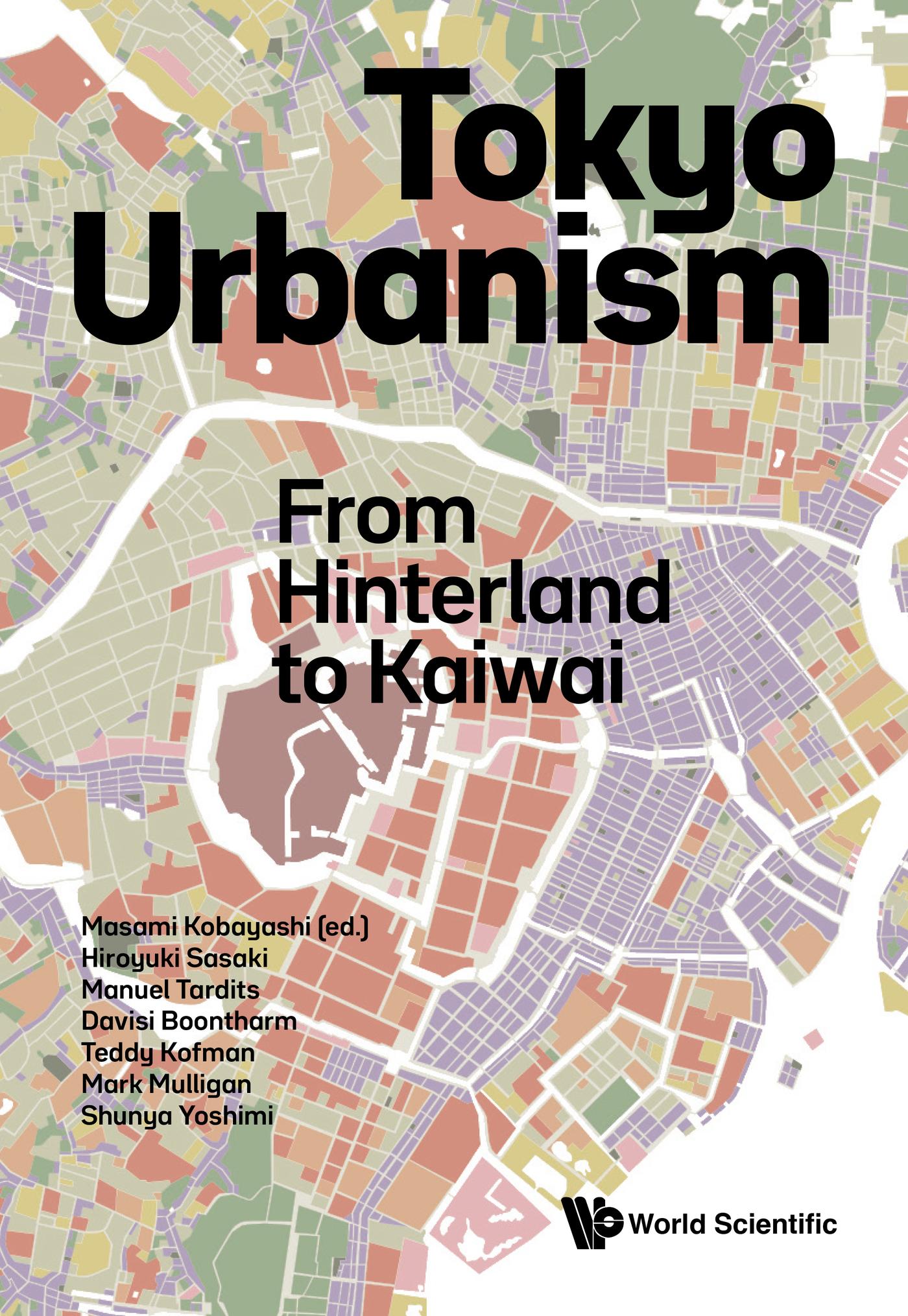
Arguably one of the most iconic mega-cities in Asia, Tokyo, the capital of Japan, plays an important economic and cultural role. It has been featured in various media as a liveable city with a well-developed public transport system. Yet, what international media coverage often misses out are its unique neighbourhoods and districts. Known as kaiwai, they are scattered in a mosaic from downtown Tokyo to its suburbs, exemplifying a type of urbanism wholly unique to Asia and foreshadowing a future vision which suggests regional autonomy in a post-COVID-19 world.
In this book, the authors thoroughly investigate the city's multi-layered spatial and sociocultural aspects, introducing a side of Tokyo little known to the world at large. Readers who are only familiar with Tokyo's depiction as an ultra-modern city will appreciate the book's insights into the kaiwai phenomenon, the pre-modern urban structure of Edo city, and contemporary Tokyo's Asian urbanism, including traditional community activities such as local festivals, the formation of new communities by old and new residents, and intimate community life using a network of alleys. Combining urban planning, sociological, anthropological and architectural perspectives, the book's interdisciplinary approach looks at Tokyo from the peripherical to the kaiwai-level.
Contents:
- Preface:
- Researches and Studies About Urban and Architectural Environment of Tokyo (Masami Kobayashi)
- Introduction:
- A Wondrous Experiment: Tokyo's Evolving Urbanism (Mark Mulligan)
- The Layers of Occupied Tokyo. From Ancient Archipelago to Postwar Olympic City (Shunya Yoshimi)
- Urban Transformation from Edo to Tokyo. Process of Fragmented Structure of the City (Masami Kobayashi)
- Elementary Structure of the Metropolis (Manuel Tardits)
- The Hidden Layers of Tokyo's Urban Unit (Masami Kobayashi and Teddy Kofman)
- Kaiwai as Activity Spaces: Transformation and Current Status of Kaiwai Around Shibuya, Tokyo (Hiroyuki Sasaki)
- Tokyo Requalified: Artistic Sensibility for Cultural Sustainability (Davisi Boontharm)
- Roundtable Discussion
- Conclusion:
- Round table / Discussion (Masami Kobayashi, Hiroyuki Sasaki, Manuel Tardits, Davisi Boontharm, Mark Mulligan and Teddy Kofman)
Readership: Advanced graduate students, researchers in the field of urban design and architecture, Japan studies students and researchers.
Key Features:
- Adopts an interdisciplinary perspective, combining urban planning, architectural, sociological and anthropological approaches, to analysing Tokyo's city planning
- Proposes a new theory of Asian cities and urbanism using Tokyo as a case study
- Offers insight into Tokyo's unique neighbourhoods and districts
Betala smidigt med kort, Klarna, Apple Pay eller Google Pay. Är du inte nöjd har du alltid 14 dagars ångerrätt. Läs mer i våra villkor. Har du några frågor, mejla oss på hello@memmo.org.
Memmo gör det enklare att plugga – var du än är i världen. Hos oss samlar du kursböcker och smarta studieverktyg på ett och samma ställe: sammanfattningar, quiz, poddar och flashcards. Och så Ted, din studiekompis som svarar på allt du undrar. Över 75 000 studenter pluggar redan här – byggt för att du ska lära dig snabbare och stressa mindre.