
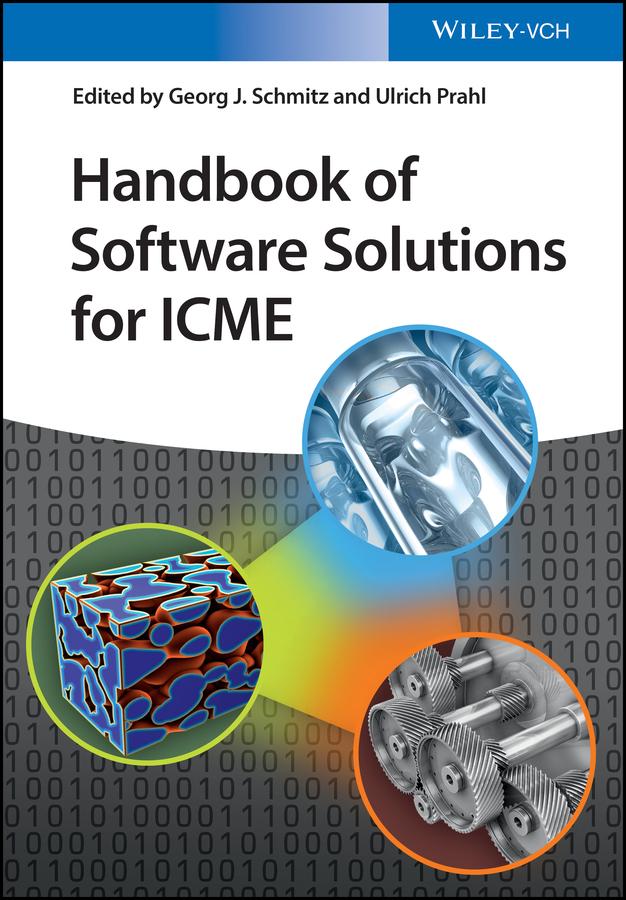
As one of the results of an ambitious project, this handbook provides a well-structured directory
of globally available software tools in the area of Integrated Computational Materials
Engineering (ICME).
The compilation covers models, software tools, and numerical methods allowing describing
electronic, atomistic, and mesoscopic phenomena, which in their combination determine the
microstructure and the properties of materials. It reaches out to simulations of component
manufacture comprising primary shaping, forming, joining, coating, heat treatment, and
machining processes. Models and tools addressing the in-service behavior like fatigue, corrosion,
and eventually recycling complete the compilation.
An introductory overview is provided for each of these different modelling areas highlighting the
relevant phenomena and also discussing the current state for the different simulation approaches.
A must-have for researchers, application engineers, and simulation software providers seeking
a holistic overview about the current state of the art in a huge variety of modelling topics.
This handbook equally serves as a reference manual for academic and commercial software developers
and providers, for industrial users of simulation software, and for decision makers seeking
to optimize their production by simulations. In view of its sound introductions into the different
fields of materials physics, materials chemistry, materials engineering and materials processing
it also serves as a tutorial for students in the emerging discipline of ICME, which requires a broad
view on things and at least a basic education in adjacent fields.
of globally available software tools in the area of Integrated Computational Materials
Engineering (ICME).
The compilation covers models, software tools, and numerical methods allowing describing
electronic, atomistic, and mesoscopic phenomena, which in their combination determine the
microstructure and the properties of materials. It reaches out to simulations of component
manufacture comprising primary shaping, forming, joining, coating, heat treatment, and
machining processes. Models and tools addressing the in-service behavior like fatigue, corrosion,
and eventually recycling complete the compilation.
An introductory overview is provided for each of these different modelling areas highlighting the
relevant phenomena and also discussing the current state for the different simulation approaches.
A must-have for researchers, application engineers, and simulation software providers seeking
a holistic overview about the current state of the art in a huge variety of modelling topics.
This handbook equally serves as a reference manual for academic and commercial software developers
and providers, for industrial users of simulation software, and for decision makers seeking
to optimize their production by simulations. In view of its sound introductions into the different
fields of materials physics, materials chemistry, materials engineering and materials processing
it also serves as a tutorial for students in the emerging discipline of ICME, which requires a broad
view on things and at least a basic education in adjacent fields.
Betala smidigt med kort, Klarna, Apple Pay eller Google Pay. Är du inte nöjd har du alltid 14 dagars ångerrätt. Läs mer i våra villkor. Har du några frågor, mejla oss på hello@memmo.org.
Memmo gör det enklare att plugga – var du än är i världen. Hos oss samlar du kursböcker och smarta studieverktyg på ett och samma ställe: sammanfattningar, quiz, poddar och flashcards. Och så Ted, din studiekompis som svarar på allt du undrar. Över 50 000 studenter pluggar redan här – byggt för att du ska lära dig snabbare och stressa mindre.