
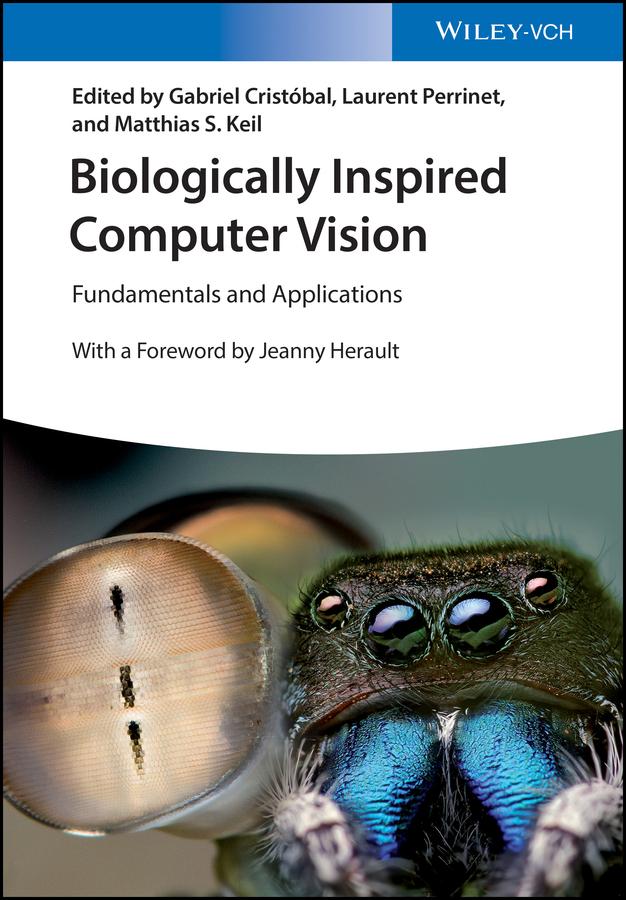
As the state-of-the-art imaging technologies became more and more advanced, yielding scientific data at unprecedented detail and volume, the need to process and interpret all the data has made image processing and computer vision increasingly important. Sources of data that have to be routinely dealt with today's applications include video transmission, wireless communication, automatic fingerprint processing, massive databanks, non-weary and accurate automatic airport screening, robust night vision, just to name a few. Multidisciplinary inputs from other disciplines such as physics, computational neuroscience, cognitive science, mathematics, and biology will have a fundamental impact in the progress of imaging and vision sciences. One of the advantages of the study of biological organisms is to devise very different type of computational paradigms by implementing a neural network with a high degree of local connectivity.
This is a comprehensive and rigorous reference in the area of biologically motivated vision sensors. The study of biologically visual systems can be considered as a two way avenue. On the one hand, biological organisms can provide a source of inspiration for new computational efficient and robust vision models and on the other hand machine vision approaches can provide new insights for understanding biological visual systems. Along the different chapters, this book covers a wide range of topics from fundamental to more specialized topics, including visual analysis based on a computational level, hardware implementation, and the design of new more advanced vision sensors. The last two sections of the book provide an overview of a few representative applications and current state of the art of the research in this area. This makes it a valuable book for graduate, Master, PhD students and also researchers in the field.
This is a comprehensive and rigorous reference in the area of biologically motivated vision sensors. The study of biologically visual systems can be considered as a two way avenue. On the one hand, biological organisms can provide a source of inspiration for new computational efficient and robust vision models and on the other hand machine vision approaches can provide new insights for understanding biological visual systems. Along the different chapters, this book covers a wide range of topics from fundamental to more specialized topics, including visual analysis based on a computational level, hardware implementation, and the design of new more advanced vision sensors. The last two sections of the book provide an overview of a few representative applications and current state of the art of the research in this area. This makes it a valuable book for graduate, Master, PhD students and also researchers in the field.
Betala smidigt med kort, Klarna, Apple Pay eller Google Pay. Är du inte nöjd har du alltid 14 dagars ångerrätt. Läs mer i våra villkor. Har du några frågor, mejla oss på hello@memmo.org.
Memmo gör det enklare att plugga – var du än är i världen. Hos oss samlar du kursböcker och smarta studieverktyg på ett och samma ställe: sammanfattningar, quiz, poddar och flashcards. Och så Ted, din studiekompis som svarar på allt du undrar. Över 50 000 studenter pluggar redan här – byggt för att du ska lära dig snabbare och stressa mindre.