
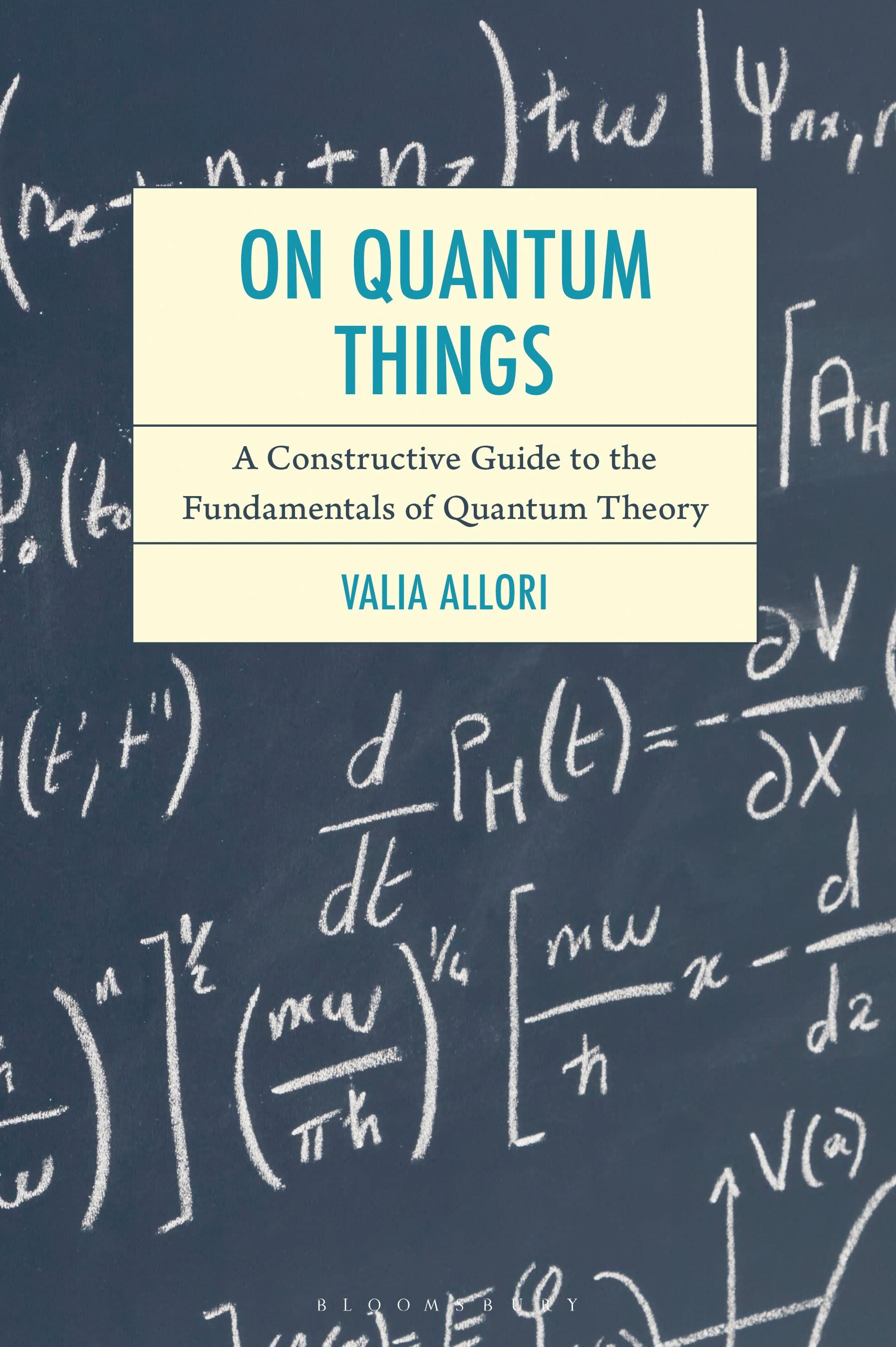
A realist, particle-based view of quantum theory-where the wavefunction no longer plays a central role-offers a clear, commonsense alternative to dominant metaphysical views.
This book explores the metaphysics of quantum theory through a lens of scientific realism-the belief that successful scientific theories describe reality. It critically evaluates various interpretations, including structural realism, wave function realism, and the many-worlds view, highlighting their limitations. Valia Allori proposes a “spatiotemporal foundational ontology” approach, grounded in particles as fundamental entities evolving in three-dimensional space and time, following uniform, symmetric laws. This view is exemplified by Bohmian mechanics (pilot-wave theory), offering a constructive, commonsensical explanation of quantum phenomena. The wave function, in this framework, is not a physical object but plays a functional, law-like role in explaining interactions. Further, the book advances a radical thesis: fundamental particles lack intrinsic properties like mass or charge and are instead “bare” objects distinguished only by the laws governing them. This thesis allows a middle path between traditional object-based metaphysics and eliminative structuralism. Ultimately, the author argues that had physics developed more rationally, instead of following a historical path shaped by contingent choices, the pilot-wave theory might have been the dominant interpretation, minimizing the proliferation of speculative alternatives.
This book explores the metaphysics of quantum theory through a lens of scientific realism-the belief that successful scientific theories describe reality. It critically evaluates various interpretations, including structural realism, wave function realism, and the many-worlds view, highlighting their limitations. Valia Allori proposes a “spatiotemporal foundational ontology” approach, grounded in particles as fundamental entities evolving in three-dimensional space and time, following uniform, symmetric laws. This view is exemplified by Bohmian mechanics (pilot-wave theory), offering a constructive, commonsensical explanation of quantum phenomena. The wave function, in this framework, is not a physical object but plays a functional, law-like role in explaining interactions. Further, the book advances a radical thesis: fundamental particles lack intrinsic properties like mass or charge and are instead “bare” objects distinguished only by the laws governing them. This thesis allows a middle path between traditional object-based metaphysics and eliminative structuralism. Ultimately, the author argues that had physics developed more rationally, instead of following a historical path shaped by contingent choices, the pilot-wave theory might have been the dominant interpretation, minimizing the proliferation of speculative alternatives.
Betala smidigt med kort, Klarna, Apple Pay eller Google Pay. Är du inte nöjd har du alltid 14 dagars ångerrätt. Läs mer i våra villkor. Har du några frågor, mejla oss på hello@memmo.org.
Memmo gör det enklare att plugga – var du än är i världen. Hos oss samlar du kursböcker och smarta studieverktyg på ett och samma ställe: sammanfattningar, quiz, poddar och flashcards. Och så Ted, din studiekompis som svarar på allt du undrar. Över 50 000 studenter pluggar redan här – byggt för att du ska lära dig snabbare och stressa mindre.