
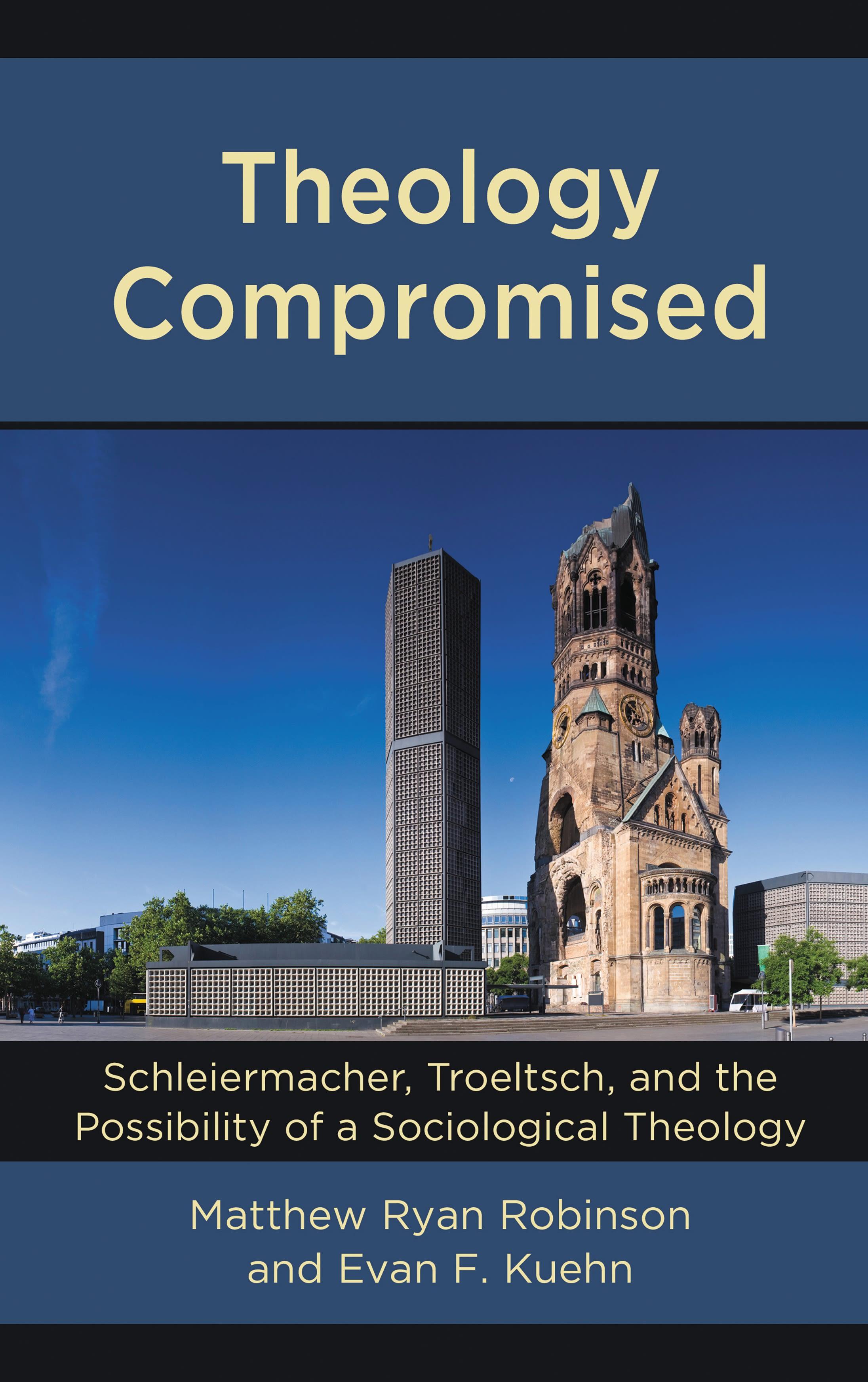
Theological work, whatever else it may be, is always a reflection on social transformations. Not only pastors but also theologians work with the sources of the Christian traditions in one hand and a newspaper in the other. But how are we to understand the relationship between social transformations and the continuously “compromised” development of Christian ideals, as these are measured by doctrinal formulations? And how might a more deeply sociological perspective on this relationship inform theological work?
Matthew Ryan Robinson and Evan F. Kuehn approach this question, not by reconstructing a history of ideas, but rather by telling a story about the development of churches and theological institutions. They take the turbulent and dynamic ecclesiological situation of nineteenth-century Germany as a representative case, focusing on the sociological methodological orientation of Friedrich Schleiermacher and Ernst Troeltsch in the context of the rise of theological liberalism, the history of religions, and the German churches’ confrontation with social and political challenges. Robinson and Kuehn then connect this orientation with the sociology of religion of Hans Joas and Niklas Luhmann, arguing for a functional focus in theological research on what doctrines do rather than what the reality behind or in any particular doctrine is.
Matthew Ryan Robinson and Evan F. Kuehn approach this question, not by reconstructing a history of ideas, but rather by telling a story about the development of churches and theological institutions. They take the turbulent and dynamic ecclesiological situation of nineteenth-century Germany as a representative case, focusing on the sociological methodological orientation of Friedrich Schleiermacher and Ernst Troeltsch in the context of the rise of theological liberalism, the history of religions, and the German churches’ confrontation with social and political challenges. Robinson and Kuehn then connect this orientation with the sociology of religion of Hans Joas and Niklas Luhmann, arguing for a functional focus in theological research on what doctrines do rather than what the reality behind or in any particular doctrine is.
Betala smidigt med kort, Klarna, Apple Pay eller Google Pay. Är du inte nöjd har du alltid 14 dagars ångerrätt. Läs mer i våra villkor. Har du några frågor, mejla oss på hello@memmo.org.
Memmo gör det enklare att plugga – var du än är i världen. Hos oss samlar du kursböcker och smarta studieverktyg på ett och samma ställe: sammanfattningar, quiz, poddar och flashcards. Och så Ted, din studiekompis som svarar på allt du undrar. Över 50 000 studenter pluggar redan här – byggt för att du ska lära dig snabbare och stressa mindre.