
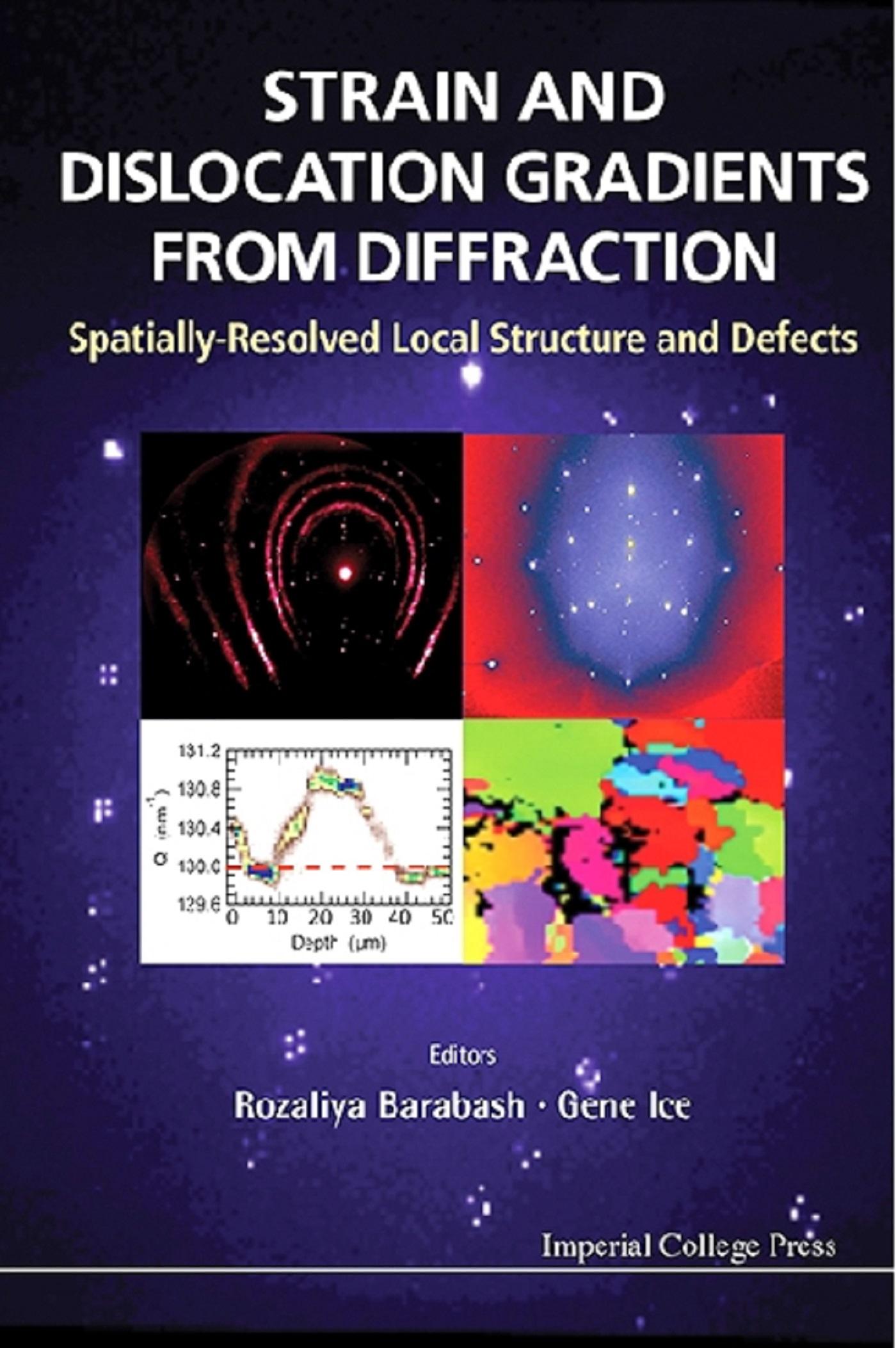
This book highlights emerging diffraction studies of strain and dislocation gradients with mesoscale resolution, which is currently a focus of research at laboratories around the world. While ensemble-average diffraction techniques are mature, grain and subgrain level measurements needed to understand real materials are just emerging. In order to understand the diffraction signature of different defects, it is necessary to understand the distortions created by the defects and the corresponding changes in the reciprocal space of the non-ideal crystals.Starting with a review of defect classifications based on their displacement fields, this book then provides connections between different dislocation arrangements, including geometrically necessary and statistically stored dislocations, and other common defects and the corresponding changes in the reciprocal space and diffraction patterns. Subsequent chapters provide an overview of microdiffraction techniques developed during the last decade to extract information about strain and dislocation gradients. X-ray microdiffraction is a particularly exciting application compared with alternative probes of local crystalline structure, orientation and defect density, because it is inherently non-destructive and penetrating.
Betala smidigt med kort, Klarna, Apple Pay eller Google Pay. Är du inte nöjd har du alltid 14 dagars ångerrätt. Läs mer i våra villkor. Har du några frågor, mejla oss på hello@memmo.org.
Memmo gör det enklare att plugga – var du än är i världen. Hos oss samlar du kursböcker och smarta studieverktyg på ett och samma ställe: sammanfattningar, quiz, poddar och flashcards. Och så Ted, din studiekompis som svarar på allt du undrar. Över 50 000 studenter pluggar redan här – byggt för att du ska lära dig snabbare och stressa mindre.
Du kanske också gillar
Köp boken0