
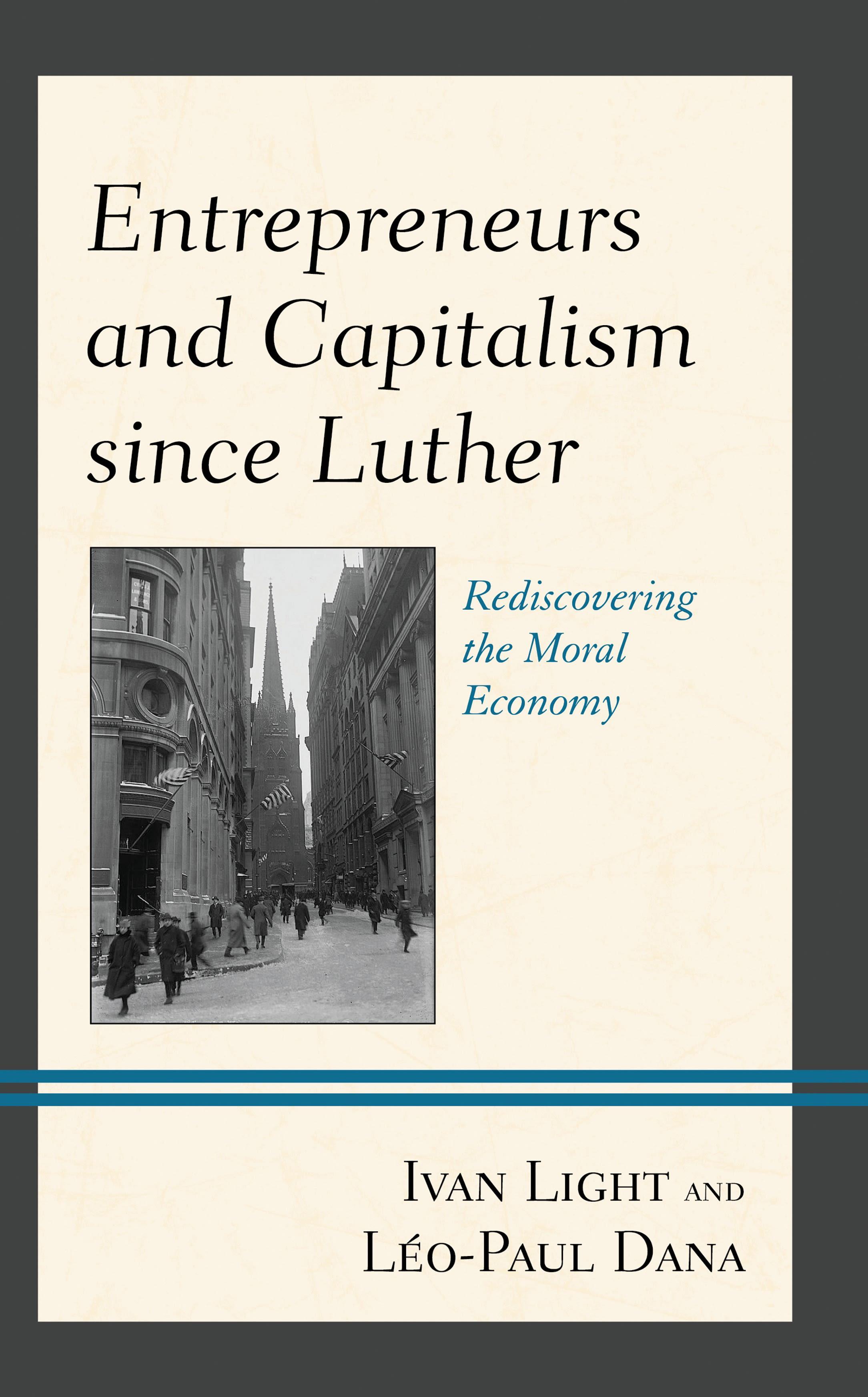
In Entrepreneurs and Capitalism since Luther: Rediscovering the Moral Economy, Ivan Light and Léo-Paul Dana study the history of business, capitalism, and entrepreneurship to examine the values of social and cultural capital. Six chapters evaluate case studies that illustrate contrasting relationships between social networks, vocational culture, and entrepreneurship. Light and Dana argue that, in capitalism’s early stages, cultural capital is scarcer than social capital and therefore more crucial for business owners. Conversely, when capitalism is well established, social capital is scarcer than cultural capital and becomes more crucial. Light and Dana then trace moral legitimations of capitalism from the Reformation to the Enlightenment, the Gilded Age, and finally to Joseph Schumpeter whose concept of “creative destruction” freed elite entrepreneurs from moral restraints that encumber small business owners. After examining the availability of social and cultural capital in the contemporary United States, Light and Dana show that business owners’ social capital enforces conventional morality in markets, facilitating commerce and legitimating small businesses the old-fashioned way. As their networks become more isolated, elite entrepreneurs must claim and ultimately deliver successful results to earn public toleration of immoral or predatory conduct.
Betala smidigt med kort, Klarna, Apple Pay eller Google Pay. Är du inte nöjd har du alltid 14 dagars ångerrätt. Läs mer i våra villkor. Har du några frågor, mejla oss på hello@memmo.org.
Memmo gör det enklare att plugga – var du än är i världen. Hos oss samlar du kursböcker och smarta studieverktyg på ett och samma ställe: sammanfattningar, quiz, poddar och flashcards. Och så Ted, din studiekompis som svarar på allt du undrar. Över 50 000 studenter pluggar redan här – byggt för att du ska lära dig snabbare och stressa mindre.