
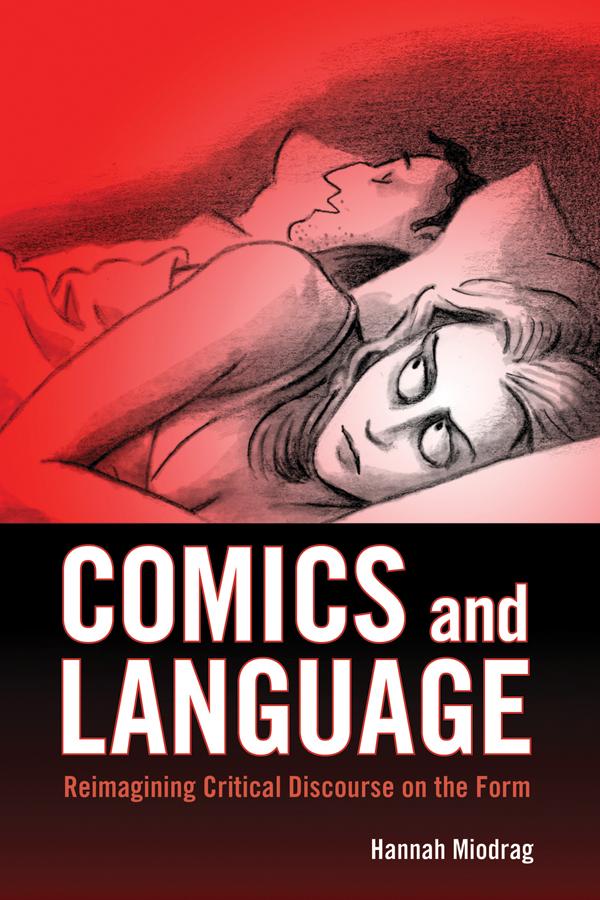
It has become an axiom in comic studies that “comics is a language, not a genre.” But what exactly does that mean, and how is discourse on the form both aided and hindered by thinking of it in linguistic terms? In Comics and Language, Hannah Miodrag challenges many of the key assumptions about the “grammar” and formal characteristics of comics, and offers a more nuanced, theoretical framework that she argues will better serve the field by offering a consistent means for communicating critical theory in the scholarship. Through engaging close readings and an accessible use of theory, this book exposes the problems embedded in the ways critics have used ideas of language, literature, structuralism, and semiotics, and sets out a new and more theoretically sound way of understanding how comics communicate.
Comics and Language argues against the critical tendency to flatten the distinctions between language and images and to discuss literature purely in terms of story content. It closely examines the original critical theories that such arguments purport to draw on and shows how they in fact point away from the conclusions they are commonly used to prove. The book improves the use the field makes of existing scholarly disciplines and furthers the ongoing sophistication of the field. It provides animated and insightful analyses of a range of different texts and takes an interdisciplinary approach. Comics and Language will appeal to the general comics reader and will prove crucial for specialized scholars in the fields of comics, literature, cultural studies, art history, and visual studies. It also provides a valuable summary of the current state of formalist criticism within comics studies and so presents the ideal text for those interested in exploring this growing area of research.
Comics and Language argues against the critical tendency to flatten the distinctions between language and images and to discuss literature purely in terms of story content. It closely examines the original critical theories that such arguments purport to draw on and shows how they in fact point away from the conclusions they are commonly used to prove. The book improves the use the field makes of existing scholarly disciplines and furthers the ongoing sophistication of the field. It provides animated and insightful analyses of a range of different texts and takes an interdisciplinary approach. Comics and Language will appeal to the general comics reader and will prove crucial for specialized scholars in the fields of comics, literature, cultural studies, art history, and visual studies. It also provides a valuable summary of the current state of formalist criticism within comics studies and so presents the ideal text for those interested in exploring this growing area of research.
Betala smidigt med kort, Klarna, Apple Pay eller Google Pay. Är du inte nöjd har du alltid 14 dagars ångerrätt. Läs mer i våra villkor. Har du några frågor, mejla oss på hello@memmo.org.
Memmo gör det enklare att plugga – var du än är i världen. Hos oss samlar du kursböcker och smarta studieverktyg på ett och samma ställe: sammanfattningar, quiz, poddar och flashcards. Och så Ted, din studiekompis som svarar på allt du undrar. Över 50 000 studenter pluggar redan här – byggt för att du ska lära dig snabbare och stressa mindre.
Du kanske också gillar
Köp boken0