
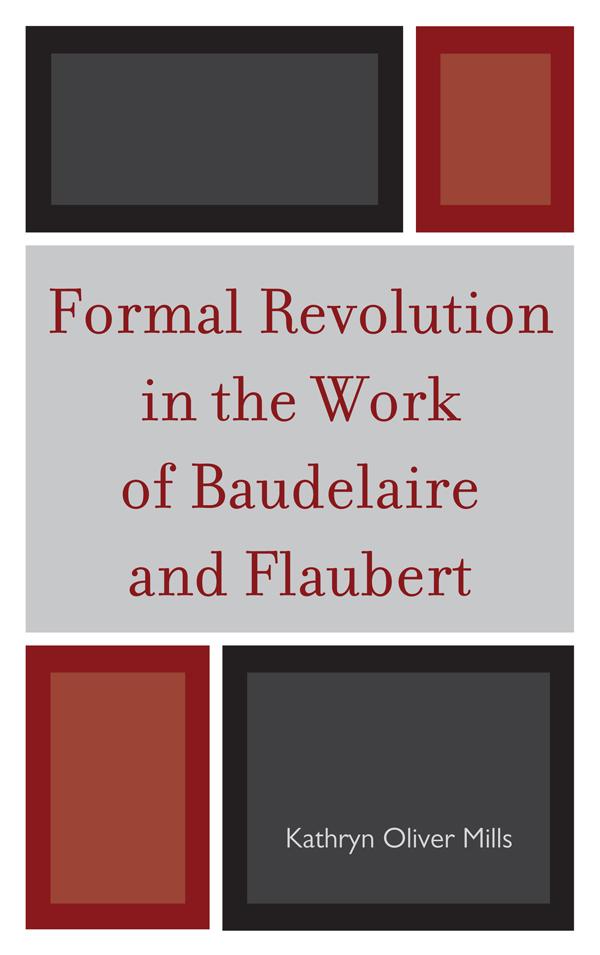
In Formal Revolution in the Work of Baudelaire and Flaubert, Kathryn Oliver Mills argues that despite the enduring celebrity of Baudelaire and Flaubert, their significance to modern art has been miscast and misunderstood. To date, literary criticism has paid insufficient attention to these authors' literary form and their socio-cultural context. In addition, critical literature has not always adequately integrated individual works to each author’s broader oeuvre: on the one hand critics do not often maintain rigorous distinctions among texts when discussing Baudelaire and Flaubert, and on the other hand scholars of Baudelaire and Flaubert have not consistently considered the relationship of individual texts to either writer’s corpus. Furthermore, critical focus has been on the modernity of Les Fleurs du mal, Madame Bovary, and L'Education Sentimentale. Addressing these lacunae in scholarship, Mills puts forth the argument that Baudelaire's collection of prose poems, Le Spleen de Paris, and Flaubert's short, poetic tales, Trois contes, best embody the modern aesthetic that Baudelaire develops in Le Peintre de la vie moderne and that Flaubert elaborates in his correspondence. Formal Revolution places these relatively less well-known but last published works in relationship with the artistic goals of their authors, showing that Baudelaire and Flaubert were both acutely aware of the need to launch a new form of literature in order to literally “come to terms with” the dramatic changes transforming the nineteenth-century into the Modern Age. More specifically, Formal Revolution demonstrates that for Baudelaire and Flaubert the formal project of fusing prose with poetry—as poetic prose in the case of Flaubert, as poetry in prose in the case of Baudelaire—was crucial to their mission of “painting modern life.” This work concludes that experimentation with literary form represents these two seminal writers’ major legacy to modernity; suggests that the twentieth-century might have gone too far down that road; and speculates about the future direction of literature. The modernity of Baudelaire and Flaubert, still relevant today but often taken for granted, needs to be reexamined in light of the cultural, formal, and contextual considerations that inform Formal Revolution in the Work of Baudelaire and Flaubert.
Sidor: 194
Kategori: Litteraturvetenskap & Teori
e-ISBN: 9781611493955
Fraktvikt: 1.2 kg
Skickas inom: 1-2 dagar
Betala smidigt med kort, Klarna, Apple Pay eller Google Pay. Är du inte nöjd har du alltid 14 dagars ångerrätt. Läs mer i våra villkor. Har du några frågor, mejla oss på hello@memmo.org.
Memmo gör det enklare att plugga – var du än är i världen. Hos oss samlar du kursböcker och smarta studieverktyg på ett och samma ställe: sammanfattningar, quiz, poddar och flashcards. Och så Ted, din studiekompis som svarar på allt du undrar. Över 50 000 studenter pluggar redan här – byggt för att du ska lära dig snabbare och stressa mindre.