
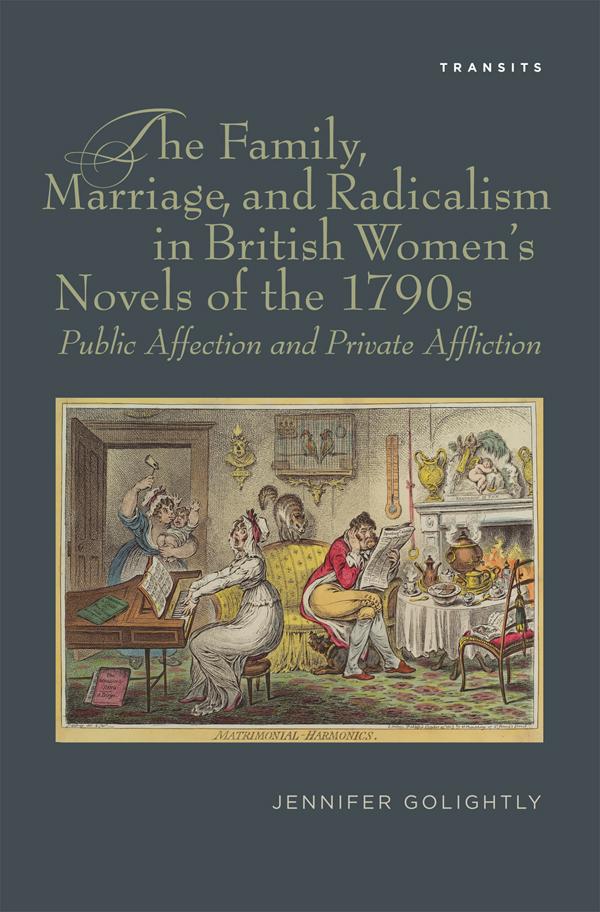
This book explores the ways in which five female radical novelists of the 1790s—Elizabeth Inchbald, Eliza Fenwick, Mary Hays, Charlotte Smith, and Mary Wollstonecraft—attempted to use the components of private life to work toward widespread social reform. These writers depict the conjugal family as the site for a potential reformation of the prejudices and flaws of the biological family. The biological family in the radical novels of female writers is fraught with problems: greed and selfishness pervert the relationships between siblings, and neglect and ignorance characterize the parenting received by the heroines. Additionally, the radical novelists, responding to representations of biological families as inherently restrictive for unmarried women, develop the notion of marriage to a certain type of man as a social duty. Marriage between two properly sensible people who have both cultivated their reason and understanding and who can live together as equals, sharing domestic responsibilities, is shown to be an ideal with the power to create social change. Positioning their depictions of marriage in opposition to earlier feminist depictions of female utopian societies, the female radical novelists of the 1790s strive to depict relationships between men and women that are characterized by cooperation, individual autonomy, and equality.
What is most important about these depictions is their ultimate failure. Most of the female radical novelists find such marriages nearly impossible to conceptualize. Marriage, for many of the female radical novelists, was an institution they perceived as inextricably related to (male) concerns about property and inescapably patriarchal under the marriage laws of late eighteenth-century British society. Unions between two worthy individuals outside the boundaries of marriage are shown in the female radical novels to be equally problematic: sex inevitably is the basis for such unions, yet sex leaves women vulnerable to exploitation by men. Rather than the triumph, therefore, of what comes to be in these novels the male-associated values of property and power through marriage, the female radical novels end by suggesting an alternative community, one that will shelter those members of society who are most frequently exploited in male attempts to accumulate this property and power: women, servants, and children.
What is most important about these depictions is their ultimate failure. Most of the female radical novelists find such marriages nearly impossible to conceptualize. Marriage, for many of the female radical novelists, was an institution they perceived as inextricably related to (male) concerns about property and inescapably patriarchal under the marriage laws of late eighteenth-century British society. Unions between two worthy individuals outside the boundaries of marriage are shown in the female radical novels to be equally problematic: sex inevitably is the basis for such unions, yet sex leaves women vulnerable to exploitation by men. Rather than the triumph, therefore, of what comes to be in these novels the male-associated values of property and power through marriage, the female radical novels end by suggesting an alternative community, one that will shelter those members of society who are most frequently exploited in male attempts to accumulate this property and power: women, servants, and children.
Sidor: 156
Kategori: Litteraturvetenskap & Teori
e-ISBN: 9781611483611
Fraktvikt: 1.2 kg
Skickas inom: 1-2 dagar
Betala smidigt med kort, Klarna, Apple Pay eller Google Pay. Är du inte nöjd har du alltid 14 dagars ångerrätt. Läs mer i våra villkor. Har du några frågor, mejla oss på hello@memmo.org.
Memmo gör det enklare att plugga – var du än är i världen. Hos oss samlar du kursböcker och smarta studieverktyg på ett och samma ställe: sammanfattningar, quiz, poddar och flashcards. Och så Ted, din studiekompis som svarar på allt du undrar. Över 50 000 studenter pluggar redan här – byggt för att du ska lära dig snabbare och stressa mindre.