
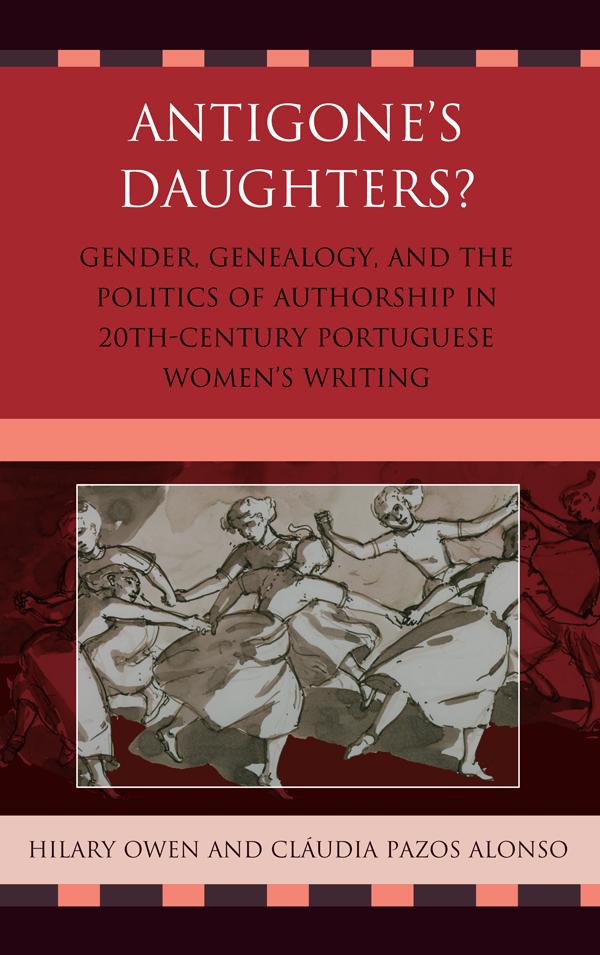
Antigone's Daughters? provides the first detailed discussion in English of six well-known Portuguese women writers, working across a wide range of genres: Florbela Espanca (1894-1930), Irene Lisboa (1892-1958), Agustina Bessa Luís, (1923- ), Natália Correia (1923-93), Hélia Correia (1949 -) and Lídia Jorge (1946 - ). Together they cover the span of the 20th century and afford historical insights into the complex gender politics of achieving institutional acceptance and validation in the Portuguese national canon at different points in the 20th century.
Although a patrilinear evolutionary model visibly structures national literary history in Portugal to the present day, women writers and critics have not generally sought to replace this with a matrilinear feminist counter-history. The unifying metaphor that the authors adopt here for the purpose of discussing Portuguese women's ambivalent response to female genealogy is the classical figure of Antigone, who paradoxically sacrifices her own genealogical continuity in the name of defending family and kinship, while resisting the patriarchal pragmatics of state-building. Should women writers, faced with the absence of a female tradition, posit a woman-centred place outside the jurisdiction of male genealogy, however strategically essentialist that place may be, or should they primarily eschew fixed sexual identity to act as unnameable saboteurs, undoing the law of patriarchal tradition from within?
Although a patrilinear evolutionary model visibly structures national literary history in Portugal to the present day, women writers and critics have not generally sought to replace this with a matrilinear feminist counter-history. The unifying metaphor that the authors adopt here for the purpose of discussing Portuguese women's ambivalent response to female genealogy is the classical figure of Antigone, who paradoxically sacrifices her own genealogical continuity in the name of defending family and kinship, while resisting the patriarchal pragmatics of state-building. Should women writers, faced with the absence of a female tradition, posit a woman-centred place outside the jurisdiction of male genealogy, however strategically essentialist that place may be, or should they primarily eschew fixed sexual identity to act as unnameable saboteurs, undoing the law of patriarchal tradition from within?
Sidor: 250
Kategori: Kultur-, Genus- & Postkoloniala studier
e-ISBN: 9781611480030
Fraktvikt: 1.2 kg
Skickas inom: 1-2 dagar
Betala smidigt med kort, Klarna, Apple Pay eller Google Pay. Är du inte nöjd har du alltid 14 dagars ångerrätt. Läs mer i våra villkor. Har du några frågor, mejla oss på hello@memmo.org.
Memmo gör det enklare att plugga – var du än är i världen. Hos oss samlar du kursböcker och smarta studieverktyg på ett och samma ställe: sammanfattningar, quiz, poddar och flashcards. Och så Ted, din studiekompis som svarar på allt du undrar. Över 50 000 studenter pluggar redan här – byggt för att du ska lära dig snabbare och stressa mindre.