
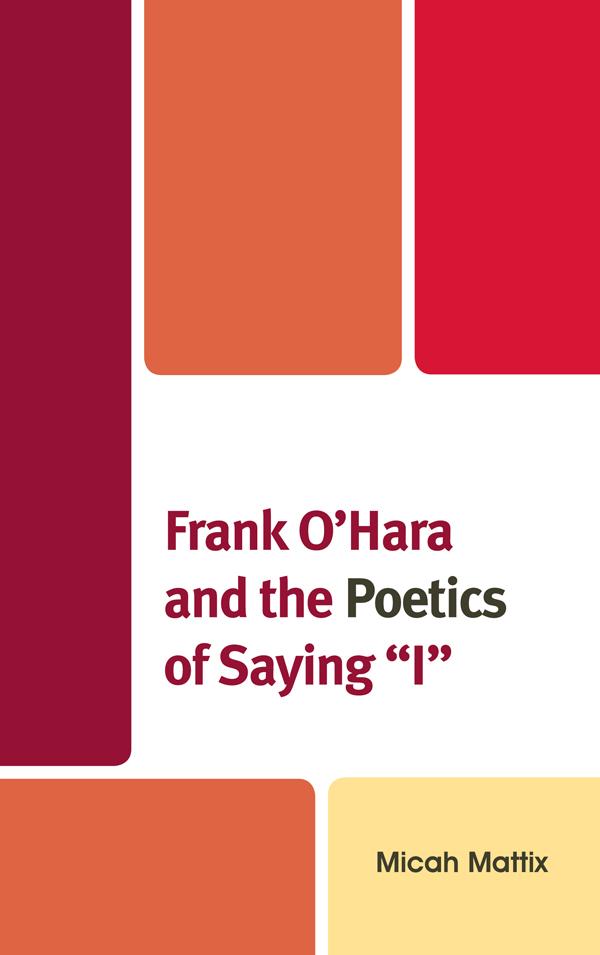
While recent works of criticism on Frank O'Hara have focused on the technical similarities between his poetry and painting, or between his use of language and poststructuralism, Frank O'Hara and the Poetics of Saying 'I' argues that what is most significant in O'Hara's work is not such much his "borrowing" from painters or his proto-Derridean use of language, but his preoccupation with self exploration and the temporal effects of his work as artifacts. Following Pasternak's understanding of artistic inspiration as an act of love for the material world, O'Hara explores moments of experience in an effort to both complicate and enrich our experience of the material world. On the one hand, in poems such as Second Avenue, for example, O'Hara works to "muddy" language through which experience is, in part, mediated with the use of parataxis, allusions, and absurd metaphors and similes. On the other, in his "I do this I do that" poems, he names the events of his lunch hour in an effort, among other things, to experience time as a moment of fullness rather than as a moment of loss.
The book argues, furthermore, that O'Hara's view of the self as both an expression of the creative force at work in the world and as the temporal aggregate of finite experiences, places him between so-called "Romantic" and "postmodern" theories of the lyric. While it is often argued that O'Hara is a forerunner of a new, critically informed, "materialist" poetics, this study concludes that O'Hara's work is somewhat less radical in its understanding of poetic meaning than is often claimed.
Moreover, while O'Hara is preoccupied with his experience in his poems, the book argues that he espouses, in some respects, a rather traditional view of love. In addition to being a metaphor for the creative act, love, for O'Hara, is the chance coming together of two entities. Yet, one of the ironies of this is that while love is, for O'Hara, a feeling that is the result of movement, or the unexpected coming together of two otherwise separ
The book argues, furthermore, that O'Hara's view of the self as both an expression of the creative force at work in the world and as the temporal aggregate of finite experiences, places him between so-called "Romantic" and "postmodern" theories of the lyric. While it is often argued that O'Hara is a forerunner of a new, critically informed, "materialist" poetics, this study concludes that O'Hara's work is somewhat less radical in its understanding of poetic meaning than is often claimed.
Moreover, while O'Hara is preoccupied with his experience in his poems, the book argues that he espouses, in some respects, a rather traditional view of love. In addition to being a metaphor for the creative act, love, for O'Hara, is the chance coming together of two entities. Yet, one of the ironies of this is that while love is, for O'Hara, a feeling that is the result of movement, or the unexpected coming together of two otherwise separ
Sidor: 182
Kategori: Litteraturvetenskap & Teori
e-ISBN: 9781611470475
Fraktvikt: 1.2 kg
Skickas inom: 1-2 dagar
Betala smidigt med kort, Klarna, Apple Pay eller Google Pay. Är du inte nöjd har du alltid 14 dagars ångerrätt. Läs mer i våra villkor. Har du några frågor, mejla oss på hello@memmo.org.
Memmo gör det enklare att plugga – var du än är i världen. Hos oss samlar du kursböcker och smarta studieverktyg på ett och samma ställe: sammanfattningar, quiz, poddar och flashcards. Och så Ted, din studiekompis som svarar på allt du undrar. Över 50 000 studenter pluggar redan här – byggt för att du ska lära dig snabbare och stressa mindre.