
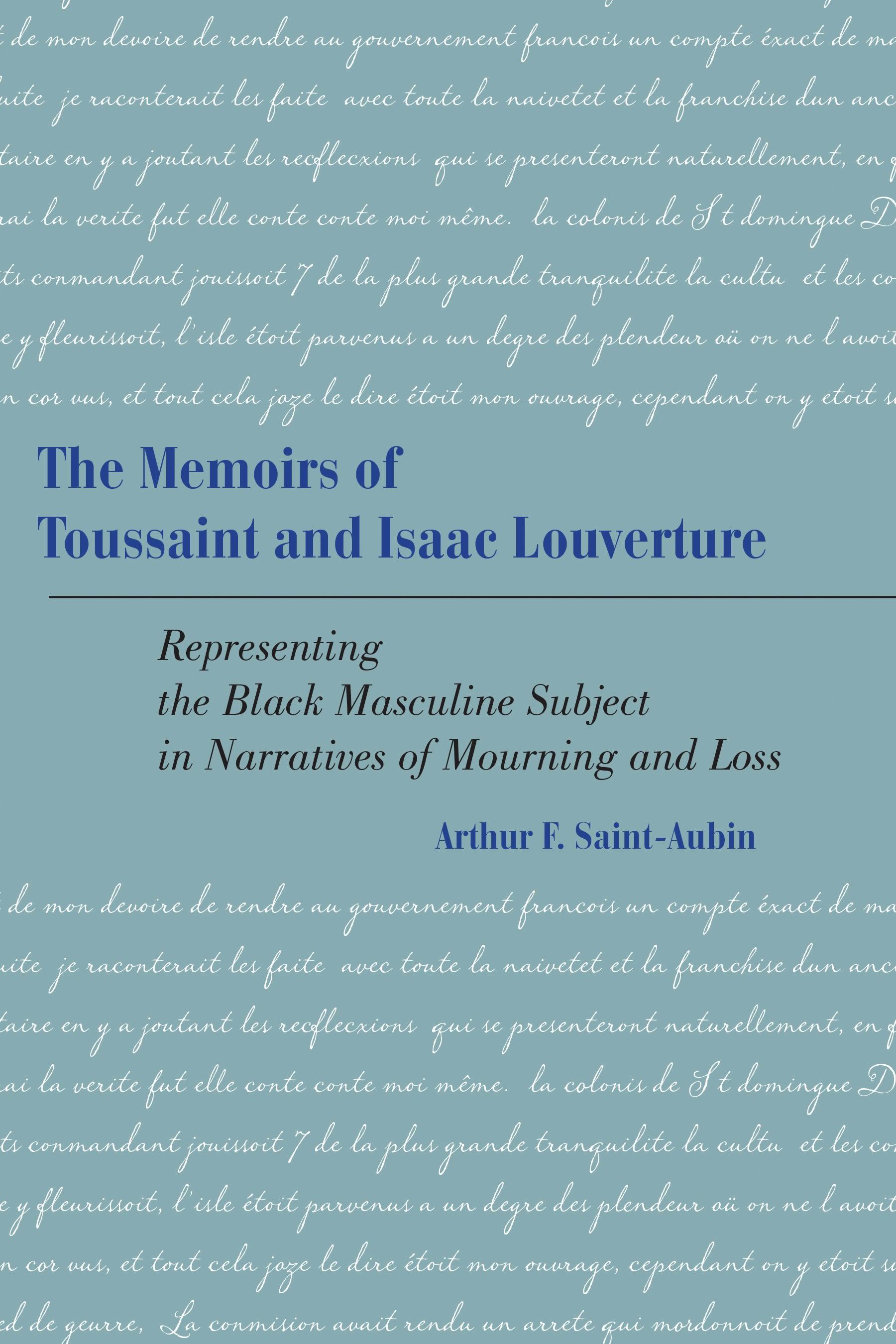
This book examines the memoir of Toussaint Louverture—a former slave, general in the French army, and leader of the Haitian Revolution—and the memoir of his son, Isaac.
The Revolution and its leaders have been studied and written about extensively. Until recently (2004), however, the memoir of Toussaint has received little attention—and only as a historical document. This is the first study that explores the 1802 work foremost as a literary text, a creative production that deploys the techniques of fiction and drama to make truth claims about the past; moreover, this is the first book-length study of Isaac Louverture’s memoir. The two texts are read as examples of how black men thought of themselves as “men” (citizens) and, therefore, how they expressed their masculinity, at that historical moment, as experiences of mourning and loss.
This study builds upon three areas of scholarship: the tradition of memoir writing; historicist readings of Toussaint’s memoir; and descriptions and theories of men and masculinity within the black Atlantic.
The study distinguishes itself in ways that will make it of interest to more than just historians: in addition to using the intersection of race and masculinity as an analytical tool, it speaks to the nature of literary creativity and it draws from studies examining the relationship between history, memory, and fiction. As a result, scholars and students in literary and cultural criticism, as well as those in gender and diasporic studies, will also find this study of interest and value.
The Revolution and its leaders have been studied and written about extensively. Until recently (2004), however, the memoir of Toussaint has received little attention—and only as a historical document. This is the first study that explores the 1802 work foremost as a literary text, a creative production that deploys the techniques of fiction and drama to make truth claims about the past; moreover, this is the first book-length study of Isaac Louverture’s memoir. The two texts are read as examples of how black men thought of themselves as “men” (citizens) and, therefore, how they expressed their masculinity, at that historical moment, as experiences of mourning and loss.
This study builds upon three areas of scholarship: the tradition of memoir writing; historicist readings of Toussaint’s memoir; and descriptions and theories of men and masculinity within the black Atlantic.
The study distinguishes itself in ways that will make it of interest to more than just historians: in addition to using the intersection of race and masculinity as an analytical tool, it speaks to the nature of literary creativity and it draws from studies examining the relationship between history, memory, and fiction. As a result, scholars and students in literary and cultural criticism, as well as those in gender and diasporic studies, will also find this study of interest and value.
Betala smidigt med kort, Klarna, Apple Pay eller Google Pay. Är du inte nöjd har du alltid 14 dagars ångerrätt. Läs mer i våra villkor. Har du några frågor, mejla oss på hello@memmo.org.
Memmo gör det enklare att plugga – var du än är i världen. Hos oss samlar du kursböcker och smarta studieverktyg på ett och samma ställe: sammanfattningar, quiz, poddar och flashcards. Och så Ted, din studiekompis som svarar på allt du undrar. Över 50 000 studenter pluggar redan här – byggt för att du ska lära dig snabbare och stressa mindre.