
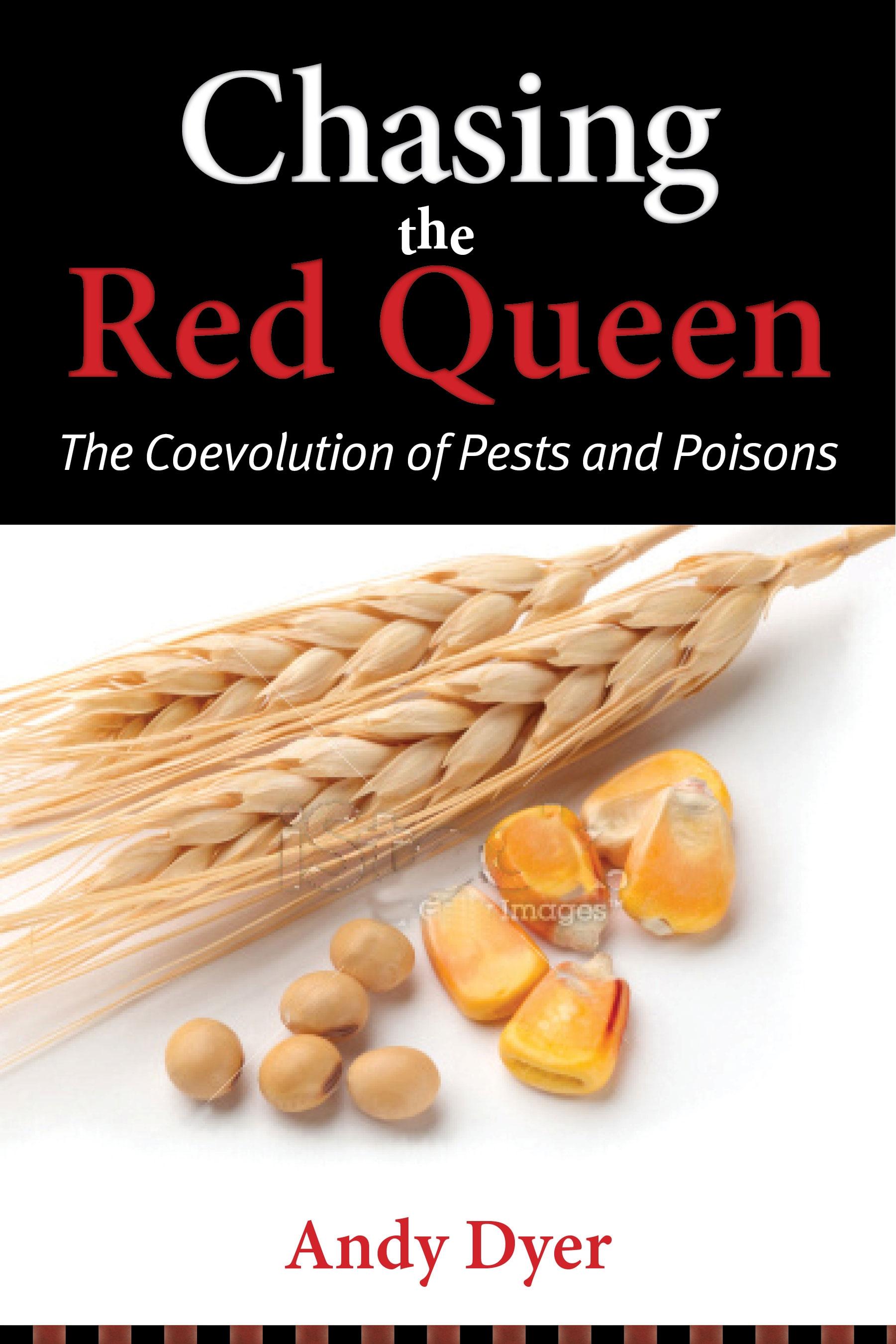
In the race to feed the world’s seven billion people, we are at a standstill. Over the past century, we have developed increasingly potent and sophisticated pesticides, yet in 2014, the average percentage of U.S. crops lost to agricultural pests was no less than in 1944. To use a metaphor the field of evolutionary biology borrowed from Alice in Wonderland, farmers must run ever faster to stay in the same place—i.e., produce the same yields.
With Chasing the Red Queen, Andy Dyer offers the first book to apply the Red Queen Hypothesis to agriculture. He illustrates that when selection pressure increases, species evolve in response, creating a never-ending, perpetually-escalating competition between predator (us) and prey (bugs and weeds). The result is farmers are caught in a vicious cycle of chemical dependence, stuck using increasingly dangerous and expensive toxics to beat back progressively resistant pests.
To break the cycle, we must learn the science behind it. Dyer examines one of the world’s most pressing problems as a biological case study. He presents key concepts, from Darwin’s principles of natural selection to genetic variation and adaptive phenotypes. Understanding the fundamentals of ecology and biology is the first step to “playing the Red Queen,” and escaping her unwinnable race. The book’s novel frame will help students, researchers, and policy-makers alike apply that knowledge to the critical task of achieving food security.
Betala smidigt med kort, Klarna, Apple Pay eller Google Pay. Är du inte nöjd har du alltid 14 dagars ångerrätt. Läs mer i våra villkor. Har du några frågor, mejla oss på hello@memmo.org.
Memmo gör det enklare att plugga – var du än är i världen. Hos oss samlar du kursböcker och smarta studieverktyg på ett och samma ställe: sammanfattningar, quiz, poddar och flashcards. Och så Ted, din studiekompis som svarar på allt du undrar. Över 50 000 studenter pluggar redan här – byggt för att du ska lära dig snabbare och stressa mindre.