
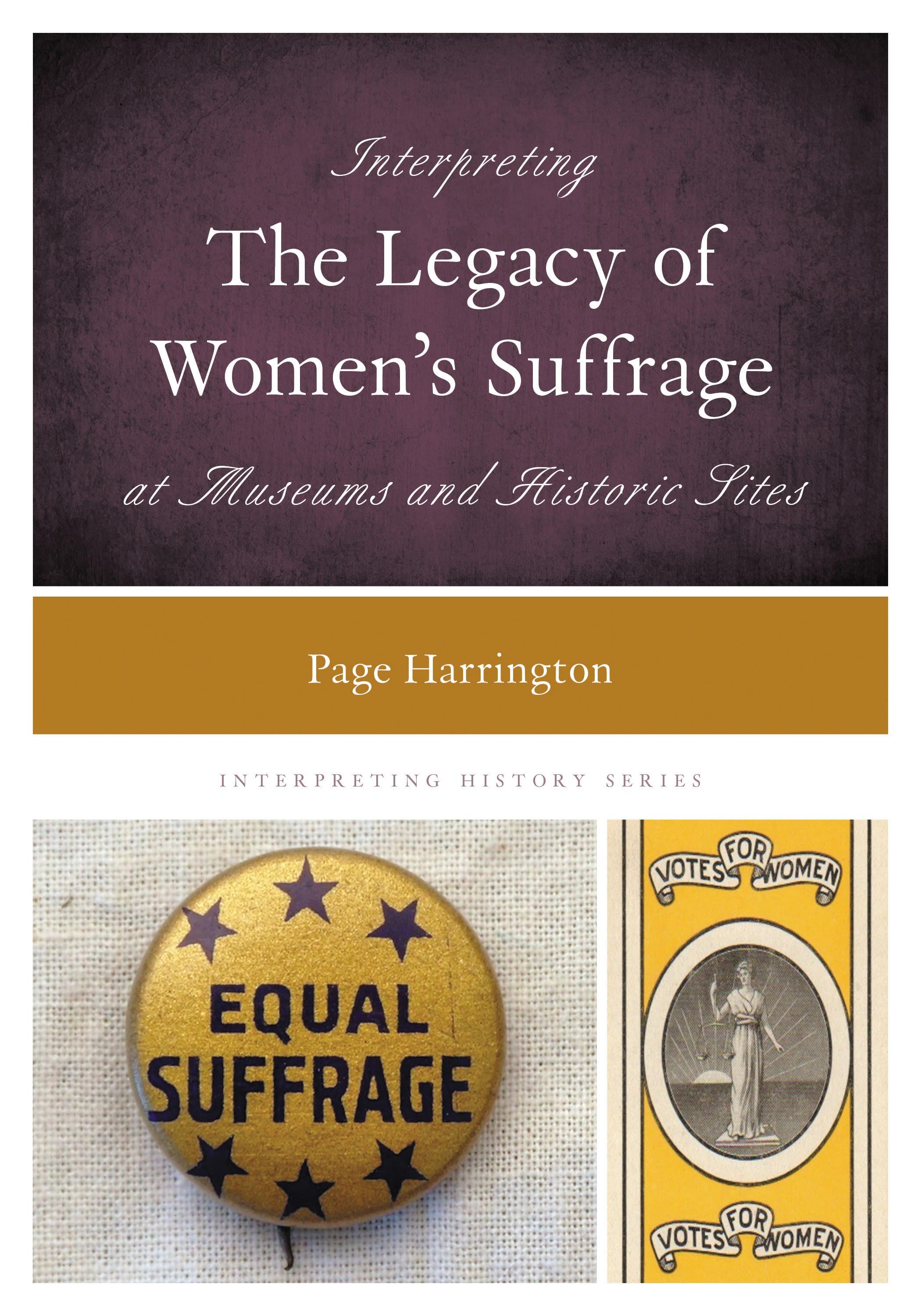
Interpreting the Legacy of Women’s Suffrage at Museums and Historic Sites is an invaluable guide for public historians and practitioners who wish to share an updated historic narrative that is inclusive of the full breadth of the movement, including the pervasive bias and racism. This book acknowledges the barriers faced by history practitioners, from the difficulty in finding materials that document the political actions by women of color, to our own reluctance to broach this disparity, and then offers practical solutions and techniques for bringing about a larger shift in organizational culture.
To begin, this book includes a chronological primer on the US women’s suffrage movement and the events around the 50th, 75th, and finally the centennial of the ratification of the 19th Amendment that took place in 2020. Additionally, four women’s history practitioners share case studies from their work at the National Woman’s Party, the Frances Willard House, and the General Federation of Women’s Clubs. Each organization is moving forward to confront the racist tactics, or documented racism within their own history. The final case study written by Chick History showcases their multi-year project to digitize and make available family and local history related to African American women’s political history in Tennessee before 1930. The case studies can be used as models for best practices, cautionary examples of lessons learned, and can be replicated at sites of all sizes.
Lastly, the book provides an expansive list of online resources as well as a discussion guide on the history of women’s voting rights. Interpreting the Legacy of Women’s Suffrage at Museums and Historic Sites will be helpful to both practitioners and community organizations as they engage in public discussions or convene focus groups around the sensitive topics of bias and racism within the larger women’s suffrage movement.
To begin, this book includes a chronological primer on the US women’s suffrage movement and the events around the 50th, 75th, and finally the centennial of the ratification of the 19th Amendment that took place in 2020. Additionally, four women’s history practitioners share case studies from their work at the National Woman’s Party, the Frances Willard House, and the General Federation of Women’s Clubs. Each organization is moving forward to confront the racist tactics, or documented racism within their own history. The final case study written by Chick History showcases their multi-year project to digitize and make available family and local history related to African American women’s political history in Tennessee before 1930. The case studies can be used as models for best practices, cautionary examples of lessons learned, and can be replicated at sites of all sizes.
Lastly, the book provides an expansive list of online resources as well as a discussion guide on the history of women’s voting rights. Interpreting the Legacy of Women’s Suffrage at Museums and Historic Sites will be helpful to both practitioners and community organizations as they engage in public discussions or convene focus groups around the sensitive topics of bias and racism within the larger women’s suffrage movement.
Sidor: 150
Kategori: Kultur-, Genus- & Postkoloniala studier
e-ISBN: 9781538118788
Fraktvikt: 1.2 kg
Skickas inom: 1-2 dagar
Betala smidigt med kort, Klarna, Apple Pay eller Google Pay. Är du inte nöjd har du alltid 14 dagars ångerrätt. Läs mer i våra villkor. Har du några frågor, mejla oss på hello@memmo.org.
Memmo gör det enklare att plugga – var du än är i världen. Hos oss samlar du kursböcker och smarta studieverktyg på ett och samma ställe: sammanfattningar, quiz, poddar och flashcards. Och så Ted, din studiekompis som svarar på allt du undrar. Över 50 000 studenter pluggar redan här – byggt för att du ska lära dig snabbare och stressa mindre.