
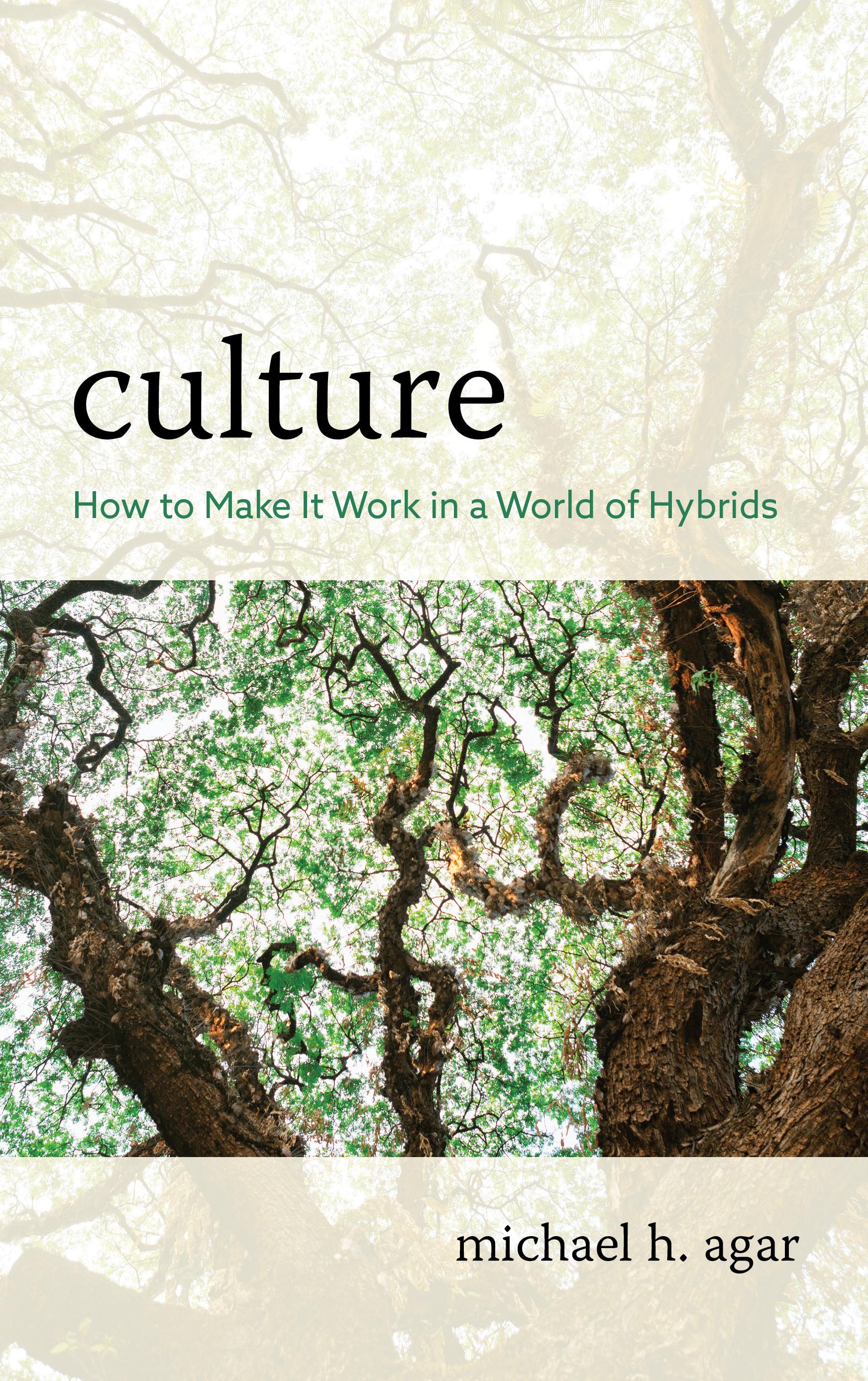
Culture: How to Make It Work in a World of Hybrids offers a compelling and original way to think about promoting connections across human differences in our global society. This book provides a fresh vision for the core anthropological concept of “culture,” one attuned to our contemporary global society where people receive hybrid cultural influences from many places in many ways.
Providing a stimulating look at one of the most basic topics in social science, it is written without academic jargon, is rich in humor, and is replete with provocative examples, making it accessible to undergraduate students in anthropology and other social sciences as well as to scholars and non-academic readers in fields where the fostering of intercultural (or, as this book argues, inter-hybrid)
communications is vital.
Michael Agar explores two meanings of culture: culture as a label for the beliefs and practices of a specific group, and culture as marking the boundary between modern humans and our ancestors together with the rest of the animal kingdom (although this book acknowledges that that boundary has changed to a slippery slope). By looking back at the emergence of language and culture, through a broad range of the social and natural sciences, those human universals that make connections across human differences possible—as well as those that constrain that ability—are identified. This book concludes with a discussion of social perspective taking as a promising approach toward the development of a shared “languaculture” by any group of diverse—hybrid—humans who need to work together to accomplish whatever task is at hand.
Providing a stimulating look at one of the most basic topics in social science, it is written without academic jargon, is rich in humor, and is replete with provocative examples, making it accessible to undergraduate students in anthropology and other social sciences as well as to scholars and non-academic readers in fields where the fostering of intercultural (or, as this book argues, inter-hybrid)
communications is vital.
Michael Agar explores two meanings of culture: culture as a label for the beliefs and practices of a specific group, and culture as marking the boundary between modern humans and our ancestors together with the rest of the animal kingdom (although this book acknowledges that that boundary has changed to a slippery slope). By looking back at the emergence of language and culture, through a broad range of the social and natural sciences, those human universals that make connections across human differences possible—as well as those that constrain that ability—are identified. This book concludes with a discussion of social perspective taking as a promising approach toward the development of a shared “languaculture” by any group of diverse—hybrid—humans who need to work together to accomplish whatever task is at hand.
Betala smidigt med kort, Klarna, Apple Pay eller Google Pay. Är du inte nöjd har du alltid 14 dagars ångerrätt. Läs mer i våra villkor. Har du några frågor, mejla oss på hello@memmo.org.
Memmo gör det enklare att plugga – var du än är i världen. Hos oss samlar du kursböcker och smarta studieverktyg på ett och samma ställe: sammanfattningar, quiz, poddar och flashcards. Och så Ted, din studiekompis som svarar på allt du undrar. Över 50 000 studenter pluggar redan här – byggt för att du ska lära dig snabbare och stressa mindre.