
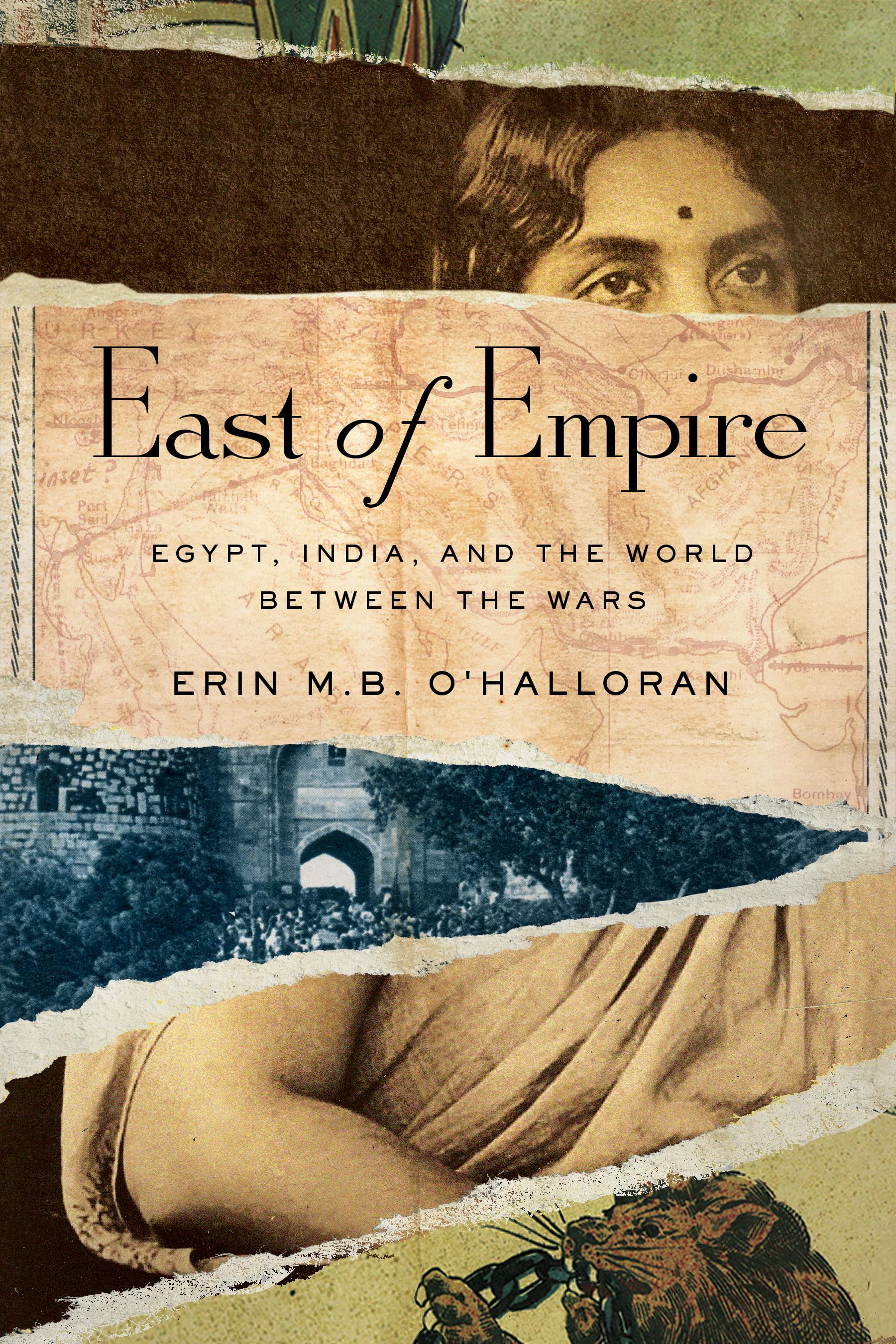
From the outset of the twentieth century, Egyptian and Indian leaders understood their movements for self-determination as linked and part of a shared project. Following World War I, as connections between the Middle East and South Asia proliferated, Egypt and India lay squarely at the heart of increasingly complex and multilateral relations. East of Empire traces how anticolonial nationalism gained momentum across the East and documents the friendships, rivalries, cultural exchanges, and shifting political alliances that came to animate the interwar project of Easternism: a cosmopolitan vision of the world whose center of gravity lay beyond Europe, in the great city of Cairo.
Erin O'Halloran offers a compelling new account of the era immediately preceding decolonization and the epochal partitions of India and Palestine. Alongside well-known figures like Mohandas K. Gandhi, Jawaharlal Nehru, and Saad Zaghlul, she introduces less familiar but no less intriguing personalities: feminists, diplomats, and poets; surrealists, socialists and spies. Each dreamed, wrote, organized and fought for the liberation of the East—a space universally evoked, though seemingly impossible to pin down. Drawing on a broad cross-section of Indian, Arab, British, and European sources, East of Empire transcends archival partitions to tell a powerful and nearly forgotten set of stories about the rise of anticolonial nationalism and the end of empire across the Middle East and South Asia.
Betala smidigt med kort, Klarna, Apple Pay eller Google Pay. Är du inte nöjd har du alltid 14 dagars ångerrätt. Läs mer i våra villkor. Har du några frågor, mejla oss på hello@memmo.org.
Memmo gör det enklare att plugga – var du än är i världen. Hos oss samlar du kursböcker och smarta studieverktyg på ett och samma ställe: sammanfattningar, quiz, poddar och flashcards. Och så Ted, din studiekompis som svarar på allt du undrar. Över 50 000 studenter pluggar redan här – byggt för att du ska lära dig snabbare och stressa mindre.