
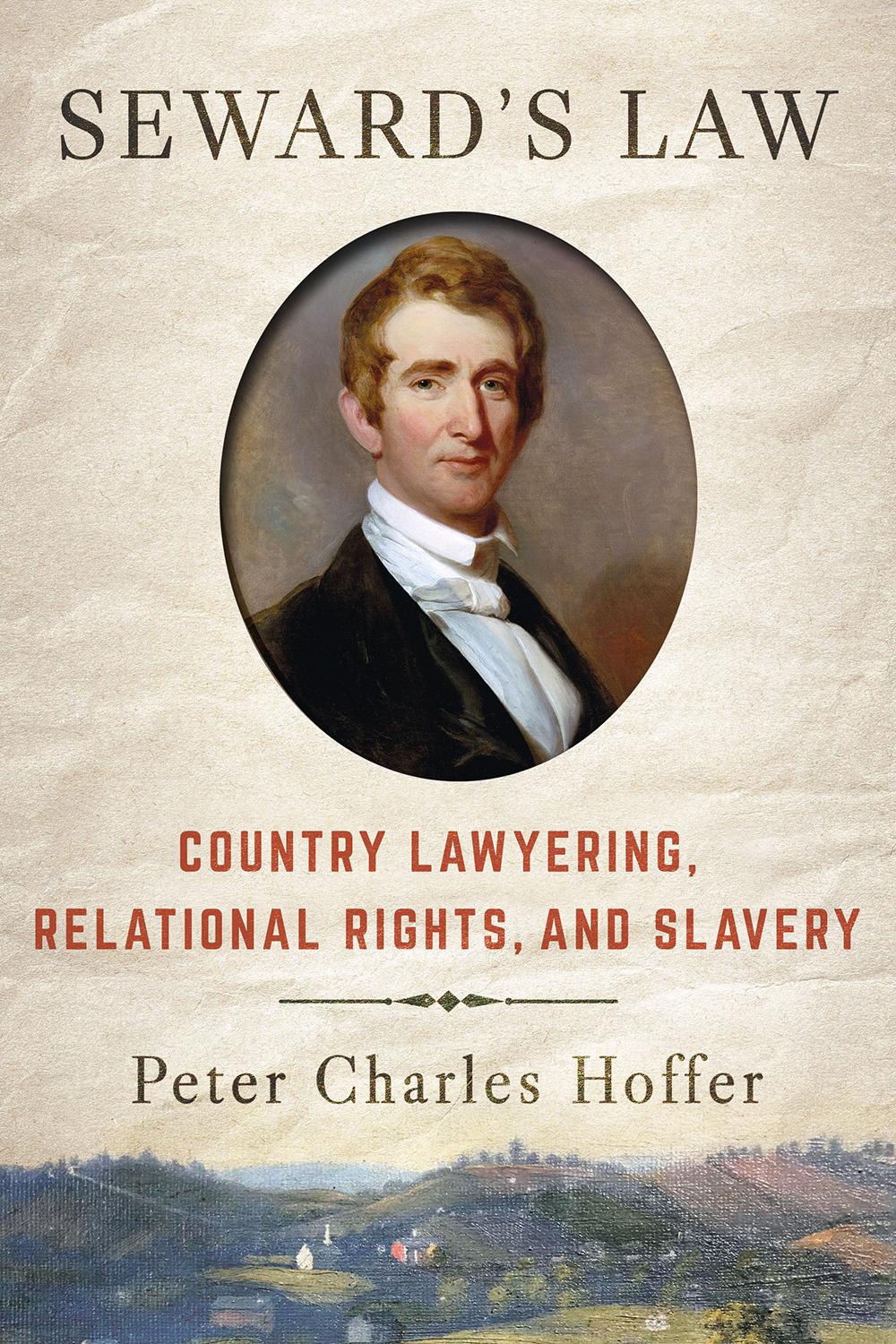
In Seward's Law, Peter Charles Hoffer argues that William H. Seward's legal practice in Auburn, New York, informed his theory of relational rights—a theory that demonstrated how the country could end slavery and establish a practical form of justice. This theory, Hoffer demonstrates, had ties to Seward's career as a country lawyer. Despite his rise to prominence, and indeed preeminence, as a US secretary of state, Seward's country-lawyer mentality endured throughout his life, as evinced in his personal attitudes and professional conduct.
Relational rights, identified and termed here for the first time by Hoffer, are communal and reciprocal, what everyone owed to every other member of their community. Such rights are at the center of a jurisprudential outlook that arises directly from living in a village. Though Seward was limited by the Victorian mores and the racialist presumptions of his day, the concept of relational rights that animated him was the natural antithesis to the theories and practices of slavery. In the legal regime underpinning the institution, masters owed nothing to their bondmen and women, while those enslaved unconditionally owed life and labor to their masters. The irrepressible conflict was, for Seward, jurisprudential as well as moral and political.
Hoffer's leading assumption in Seward's Law is that a lifetime spent as a lawyer influences how a person responds to everyday challenges. Seward remained a country lawyer at heart, and that fact defined the course of his political career.
Betala smidigt med kort, Klarna, Apple Pay eller Google Pay. Är du inte nöjd har du alltid 14 dagars ångerrätt. Läs mer i våra villkor. Har du några frågor, mejla oss på hello@memmo.org.
Memmo gör det enklare att plugga – var du än är i världen. Hos oss samlar du kursböcker och smarta studieverktyg på ett och samma ställe: sammanfattningar, quiz, poddar och flashcards. Och så Ted, din studiekompis som svarar på allt du undrar. Över 50 000 studenter pluggar redan här – byggt för att du ska lära dig snabbare och stressa mindre.