
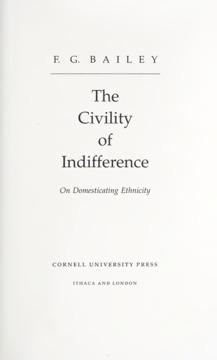
The dissolution of Yugoslavia inspired F. G. Bailey to consider the relations among ethnic groups that had seemed reconciled to living together and then broke into murderous conflicts. For his exploration of the ancient, recurring problem of ethnic strife, Bailey considers the village of Bisipara in the state of Orissa, in eastern India.
Bisipara was a community in which different ethnic groups were seen as distinct breeds of people, arranged in a hierarchy of worthiness. In The Civility of Indifference, Bailey documents a case of ethnic strife that threatened the village forty years ago but did not consume it in bloodshed. The restraint, he suggests, reflected not compassion but a sense of inevitability. The people of Bisipara perceived the world in such a way that violence enacted as ethnic cleansing would have seemed to them a disastrous indulgence and a sure path to self-destruction. Their story serves as a parable of pragmatic indifference, in contrast to the fanaticism that justifies civil war.
A seasoned ethnographer, the author considers the social structure of the community, examining the multiple castes with sensitivity and respect. His detailed description reveals the competing moral visions held by various groups and his conclusions open a new perspective on ethnic violence.
Betala smidigt med kort, Klarna, Apple Pay eller Google Pay. Är du inte nöjd har du alltid 14 dagars ångerrätt. Läs mer i våra villkor. Har du några frågor, mejla oss på hello@memmo.org.
Memmo gör det enklare att plugga – var du än är i världen. Hos oss samlar du kursböcker och smarta studieverktyg på ett och samma ställe: sammanfattningar, quiz, poddar och flashcards. Och så Ted, din studiekompis som svarar på allt du undrar. Över 50 000 studenter pluggar redan här – byggt för att du ska lära dig snabbare och stressa mindre.