
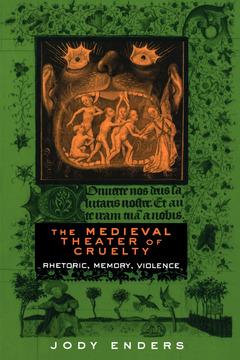
Why did medieval dramatists weave so many scenes of torture into their plays? Exploring the cultural connections among rhetoric, law, drama, literary creation, and violence, Jody Enders addresses an issue that has long troubled students of the Middle Ages. Theories of rhetoric and law of the time reveal, she points out, that the ideology of torture was a widely accepted means for exploiting such essential elements of the stage and stagecraft as dramatic verisimilitude, pity, fear, and catharsis to fabricate truth.
Analyzing the consequences of torture for the history of aesthetics in general and of drama in particular, Enders shows that if the violence embedded in the history of rhetoric is acknowledged, we are better able to understand not only the enduring "theater of cruelty" identified by theorists from Isidore of Seville to Antonin Artaud, but also the continuing modern devotion to the spectacle of pain.
Betala smidigt med kort, Klarna, Apple Pay eller Google Pay. Är du inte nöjd har du alltid 14 dagars ångerrätt. Läs mer i våra villkor. Har du några frågor, mejla oss på hello@memmo.org.
Memmo gör det enklare att plugga – var du än är i världen. Hos oss samlar du kursböcker och smarta studieverktyg på ett och samma ställe: sammanfattningar, quiz, poddar och flashcards. Och så Ted, din studiekompis som svarar på allt du undrar. Över 50 000 studenter pluggar redan här – byggt för att du ska lära dig snabbare och stressa mindre.