
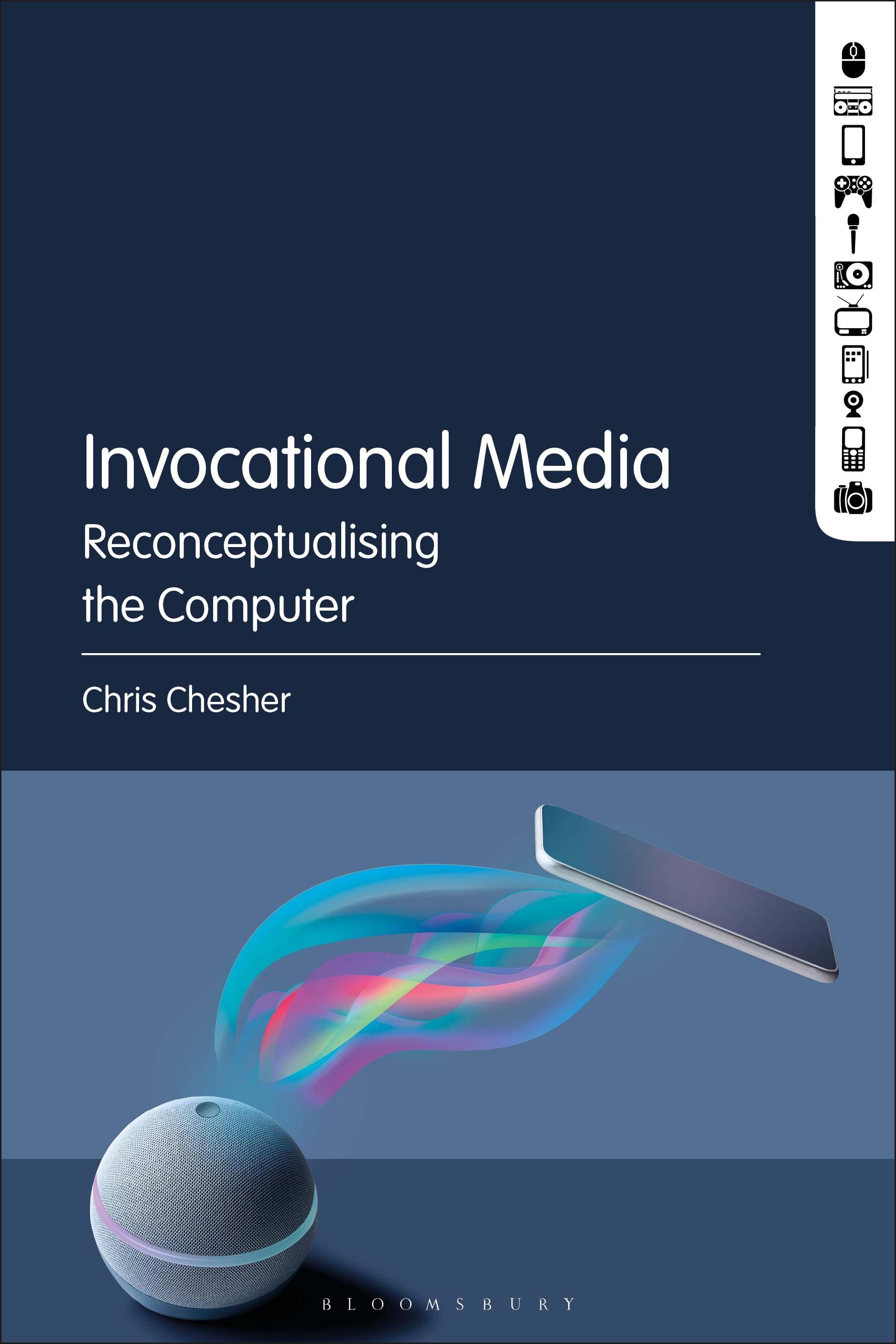
Invocational Media critiques the sociotechnical power of digital technologies by introducing the concept of invocational media.
What is an invocation? Ask your voice assistant and it will define it for you. It is a media artefact that responds to many invocations such as seeking the weather forecast, requesting any song you can name, or turning on the lights, almost magically. This contemporary manifestation of the ancient practice of invocation gives an immediate response to your call in a way that Chris Chesher argues is the characteristic power of all computers, which he redefines as invocational media.
This book challenges the foundations of computer science by offering invocation as a powerful new way of conceptualising digital technologies. Drawing on media philosophy, Deleuze, Guattari, Heidegger, Latour, Austin, Innis and McLuhan, it critiques the representationalism of data processing, artificial intelligence and virtual reality. Invocational media seem to empower individuals, but necessarily subject users to corporate and government monopolies of invocation. They offer many 'solutions', but only by reducing everything to the same kind of act. They complicate agency in their indifference as to whether invokers are human or non-human. With robotics they invoke material form to act physically and autonomously. People willingly make themselves invocable to surveillance and control by creating their own profiles and marking themselves with biometrics. This ground-breaking book will change how you think about digital media by showing they are, in fact, invocational media.
What is an invocation? Ask your voice assistant and it will define it for you. It is a media artefact that responds to many invocations such as seeking the weather forecast, requesting any song you can name, or turning on the lights, almost magically. This contemporary manifestation of the ancient practice of invocation gives an immediate response to your call in a way that Chris Chesher argues is the characteristic power of all computers, which he redefines as invocational media.
This book challenges the foundations of computer science by offering invocation as a powerful new way of conceptualising digital technologies. Drawing on media philosophy, Deleuze, Guattari, Heidegger, Latour, Austin, Innis and McLuhan, it critiques the representationalism of data processing, artificial intelligence and virtual reality. Invocational media seem to empower individuals, but necessarily subject users to corporate and government monopolies of invocation. They offer many 'solutions', but only by reducing everything to the same kind of act. They complicate agency in their indifference as to whether invokers are human or non-human. With robotics they invoke material form to act physically and autonomously. People willingly make themselves invocable to surveillance and control by creating their own profiles and marking themselves with biometrics. This ground-breaking book will change how you think about digital media by showing they are, in fact, invocational media.
Betala smidigt med kort, Klarna, Apple Pay eller Google Pay. Är du inte nöjd har du alltid 14 dagars ångerrätt. Läs mer i våra villkor. Har du några frågor, mejla oss på hello@memmo.org.
Memmo gör det enklare att plugga – var du än är i världen. Hos oss samlar du kursböcker och smarta studieverktyg på ett och samma ställe: sammanfattningar, quiz, poddar och flashcards. Och så Ted, din studiekompis som svarar på allt du undrar. Över 50 000 studenter pluggar redan här – byggt för att du ska lära dig snabbare och stressa mindre.