
2018 Next Generation Indie Book Awards
Winner: Memoir (Overcoming Adversity/Tragedy) and Finalist: Regional Non-Fiction
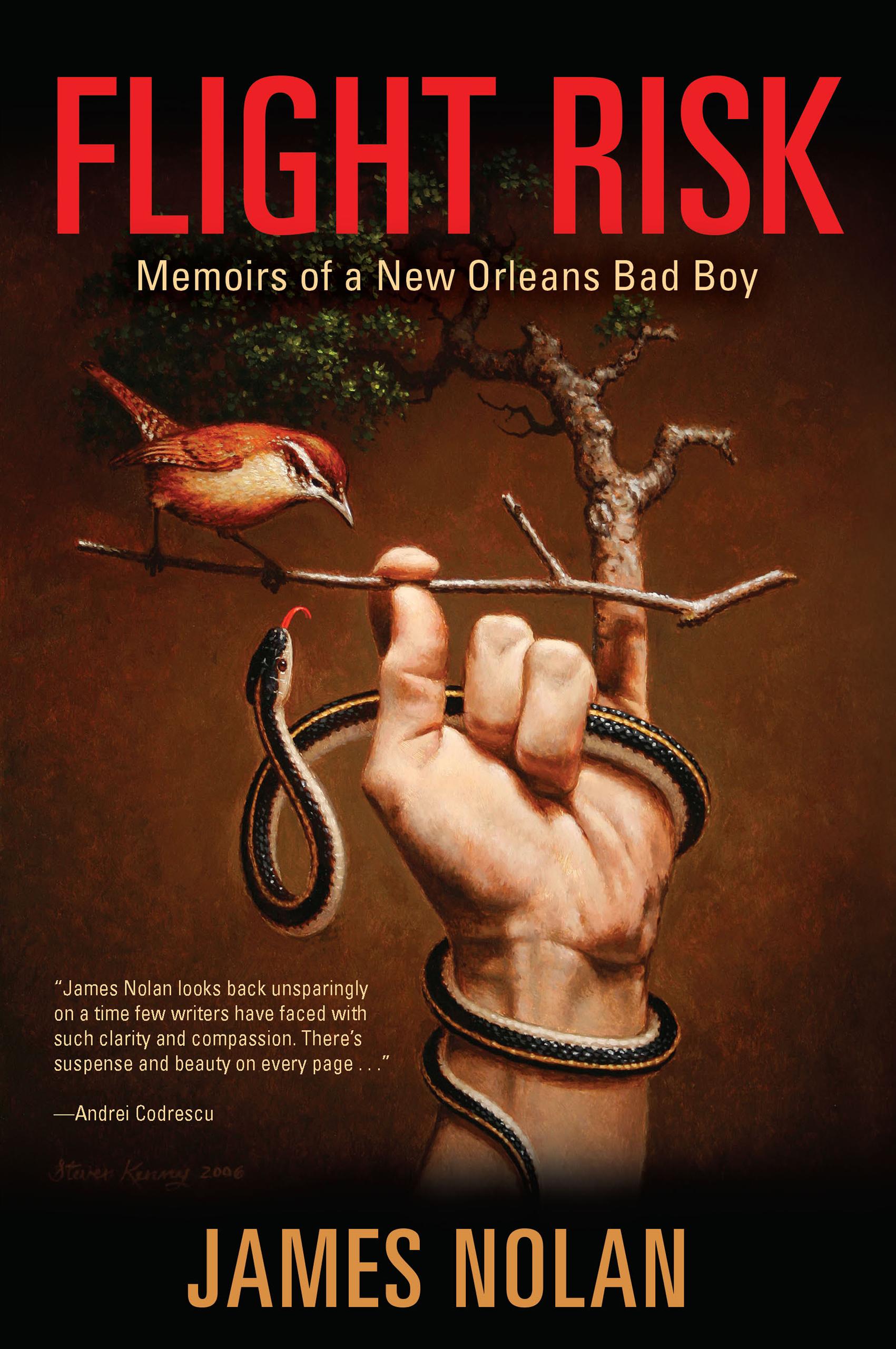
“James Nolan looks back unsparingly on a time few writers have faced with such clarity and compassion. There’s suspense and beauty on every page. . . .” —Andrei Codrescu
Flight Risk takes off as a page-turning narrative with deep roots and a wide wingspan. James Nolan, a fifth-generation New Orleans native, offers up an intimate portrait both of his insular hometown and his generation's counterculture. Flight runs as a theme throughout the book, which begins with Nolan’s escape from the gothic mental hospital to which his parents committed the teenaged poet during the tumult of 1968. This breakout is followed by the self-styled revolutionary’s hair-raising flight from a Guatemalan jail, and years later, by the author’s bolt from China, where he ditched his teaching position and collectivist ideals. These Houdini-like feats foreshadow a more recent one, how he dodged biblical floods in a stolen school bus three days after Hurricane Katrina hit New Orleans.
Nolan traces these flight patterns to those of his French ancestors who fled to New Orleans in the mid-nineteenth century, established a tobacco business in the French Quarter, and kept the old country alive in their Creole demimonde. The writer describes the eccentric Seventh Ward menagerie of the extended family in which he grew up, his early flirtation with extremist politics, and a strong bond with his freewheeling grandfather, a gentleman from the Gilded Age. Nolan’s quest for his own freedom takes him to the flower-powered, gender-bending San Francisco of the sixties and seventies, as well as to an expatriate life in Spain during the heady years of that nation’s transition to democracy. Like the prodigal son, he eventually returns home to live in the French Quarter, around the corner from where his grandmother grew up, only to struggle through the aftermath of Katrina and the city’s resurrection.
Many of these stories are entwined with the commentaries of a wry flâneur, addressing such subjects as the nuances of race in New Orleans, the Disneyfication of the French Quarter, the numbing anomie of digital technology and globalization, the challenges of caring for aging parents, Creole funeral traditions, how to make a soul-searing gumbo, and what it really means to belong.
Winner: Memoir (Overcoming Adversity/Tragedy) and Finalist: Regional Non-Fiction
“James Nolan looks back unsparingly on a time few writers have faced with such clarity and compassion. There’s suspense and beauty on every page. . . .” —Andrei Codrescu
Flight Risk takes off as a page-turning narrative with deep roots and a wide wingspan. James Nolan, a fifth-generation New Orleans native, offers up an intimate portrait both of his insular hometown and his generation's counterculture. Flight runs as a theme throughout the book, which begins with Nolan’s escape from the gothic mental hospital to which his parents committed the teenaged poet during the tumult of 1968. This breakout is followed by the self-styled revolutionary’s hair-raising flight from a Guatemalan jail, and years later, by the author’s bolt from China, where he ditched his teaching position and collectivist ideals. These Houdini-like feats foreshadow a more recent one, how he dodged biblical floods in a stolen school bus three days after Hurricane Katrina hit New Orleans.
Nolan traces these flight patterns to those of his French ancestors who fled to New Orleans in the mid-nineteenth century, established a tobacco business in the French Quarter, and kept the old country alive in their Creole demimonde. The writer describes the eccentric Seventh Ward menagerie of the extended family in which he grew up, his early flirtation with extremist politics, and a strong bond with his freewheeling grandfather, a gentleman from the Gilded Age. Nolan’s quest for his own freedom takes him to the flower-powered, gender-bending San Francisco of the sixties and seventies, as well as to an expatriate life in Spain during the heady years of that nation’s transition to democracy. Like the prodigal son, he eventually returns home to live in the French Quarter, around the corner from where his grandmother grew up, only to struggle through the aftermath of Katrina and the city’s resurrection.
Many of these stories are entwined with the commentaries of a wry flâneur, addressing such subjects as the nuances of race in New Orleans, the Disneyfication of the French Quarter, the numbing anomie of digital technology and globalization, the challenges of caring for aging parents, Creole funeral traditions, how to make a soul-searing gumbo, and what it really means to belong.
Betala smidigt med kort, Klarna, Apple Pay eller Google Pay. Är du inte nöjd har du alltid 14 dagars ångerrätt. Läs mer i våra villkor. Har du några frågor, mejla oss på hello@memmo.org.
Memmo gör det enklare att plugga – var du än är i världen. Hos oss samlar du kursböcker och smarta studieverktyg på ett och samma ställe: sammanfattningar, quiz, poddar och flashcards. Och så Ted, din studiekompis som svarar på allt du undrar. Över 50 000 studenter pluggar redan här – byggt för att du ska lära dig snabbare och stressa mindre.
Du kanske också gillar
Köp boken0