
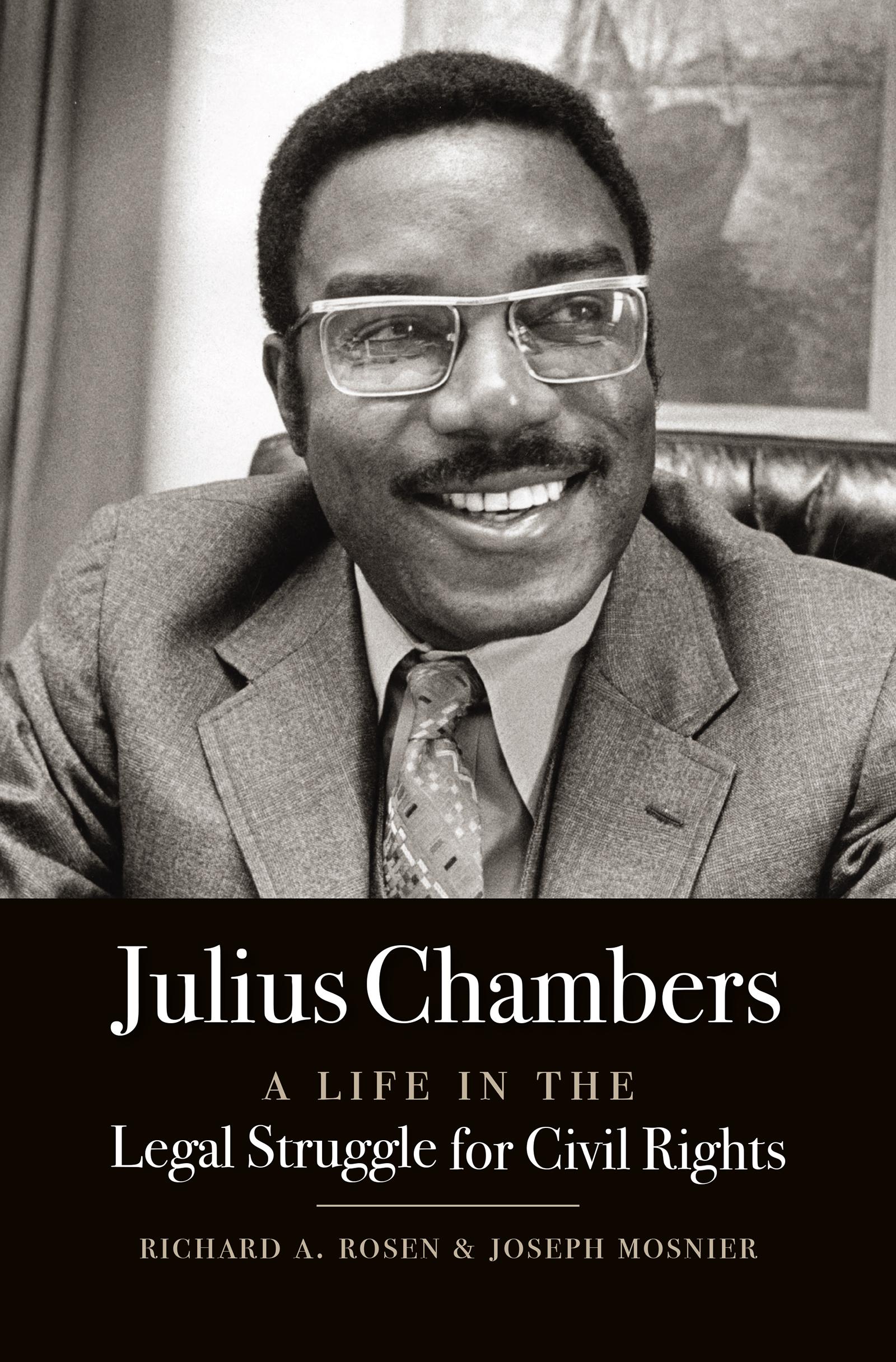
Born in the hamlet of Mount Gilead, North Carolina, Julius Chambers (1936–2013) escaped the fetters of the Jim Crow South to emerge in the 1960s and 1970s as the nation’s leading African American civil rights attorney. Following passage of the Civil Rights Act of 1964, Chambers worked to advance the NAACP Legal Defense Fund’s strategic litigation campaign for civil rights, ultimately winning landmark school and employment desegregation cases at the U.S. Supreme Court. Undaunted by the dynamiting of his home and the arson that destroyed the offices of his small integrated law practice, Chambers pushed federal civil rights law to its highwater mark.
In this biography, Richard A. Rosen and Joseph Mosnier connect the details of Chambers’s life to the wider struggle to secure racial equality through the development of modern civil rights law. Tracing his path from a dilapidated black elementary school to counsel’s lectern at the Supreme Court and beyond, they reveal Chambers’s singular influence on the evolution of federal civil rights law after 1964.
In this biography, Richard A. Rosen and Joseph Mosnier connect the details of Chambers’s life to the wider struggle to secure racial equality through the development of modern civil rights law. Tracing his path from a dilapidated black elementary school to counsel’s lectern at the Supreme Court and beyond, they reveal Chambers’s singular influence on the evolution of federal civil rights law after 1964.
Betala smidigt med kort, Klarna, Apple Pay eller Google Pay. Är du inte nöjd har du alltid 14 dagars ångerrätt. Läs mer i våra villkor. Har du några frågor, mejla oss på hello@memmo.org.
Memmo gör det enklare att plugga – var du än är i världen. Hos oss samlar du kursböcker och smarta studieverktyg på ett och samma ställe: sammanfattningar, quiz, poddar och flashcards. Och så Ted, din studiekompis som svarar på allt du undrar. Över 75 000 studenter pluggar redan här – byggt för att du ska lära dig snabbare och stressa mindre.
Du kanske också gillar
Köp boken0