
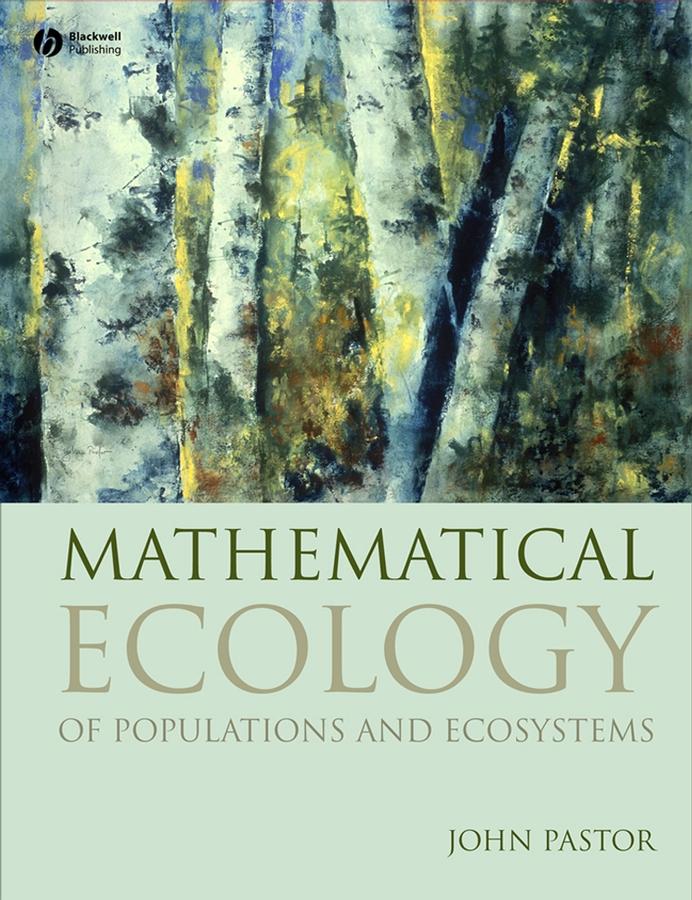
Population ecologists study how births and deaths affect the dynamics of populations and communities, while ecosystem ecologists study how species control the flux of energy and materials through food webs and ecosystems. Although all these processes occur simultaneously in nature, the mathematical frameworks bridging the two disciplines have developed independently. Consequently, this independent development of theory has impeded the cross-fertilization of population and ecosystem ecology. Using recent developments from dynamical systems theory, this advanced undergraduate/graduate level textbook shows how to bridge the two disciplines seamlessly. The book shows how bifurcations between the solutions of models can help understand regime shifts in natural populations and ecosystems once thresholds in rates of births, deaths, consumption, competition, nutrient inputs, and decay are crossed.
Mathematical Ecology is essential reading for students of ecology who have had a first course in calculus and linear algebra or students in mathematics wishing to learn how dynamical systems theory can be applied to ecological problems.
Betala smidigt med kort, Klarna, Apple Pay eller Google Pay. Är du inte nöjd har du alltid 14 dagars ångerrätt. Läs mer i våra villkor. Har du några frågor, mejla oss på hello@memmo.org.
Memmo gör det enklare att plugga – var du än är i världen. Hos oss samlar du kursböcker och smarta studieverktyg på ett och samma ställe: sammanfattningar, quiz, poddar och flashcards. Och så Ted, din studiekompis som svarar på allt du undrar. Över 50 000 studenter pluggar redan här – byggt för att du ska lära dig snabbare och stressa mindre.