
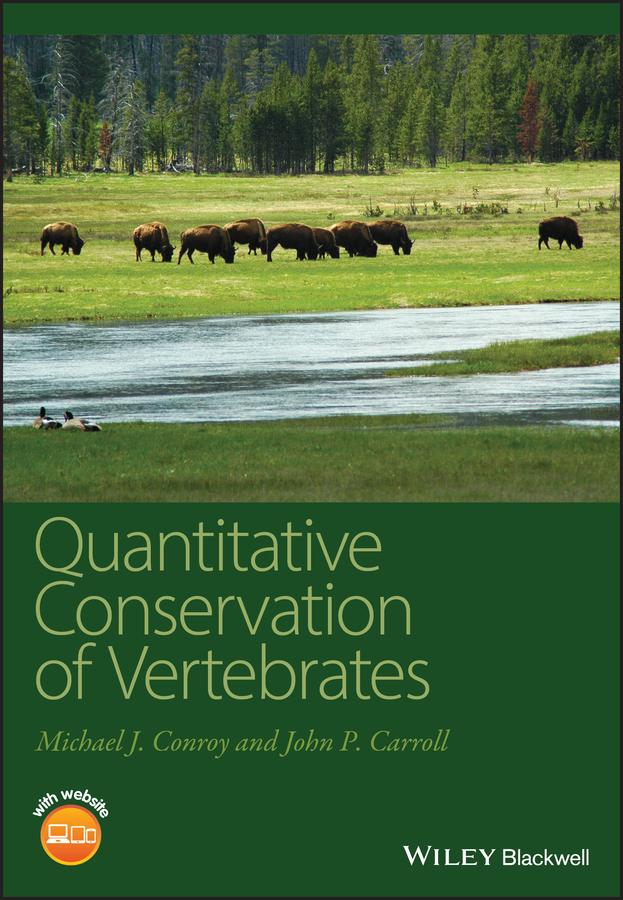
Part I provides a basic background in population and community modeling. It introduces statistical models, and familiarizes the reader with important concepts in the design of monitoring and research programs. These programs provide the essential data that guide conservation decision making. Part II covers the principal methods used to estimate abundance, occupancy, demographic parameters, and community parameters, including occupancy sampling, sample counts, distance sampling, and capture-mark-recapture (for both closed and open populations). Emphasis is placed on practical aspects of designing and implementing field studies, and the proper analysis of data. Part III introduces structured decision making and adaptive management, in which predictive models are used to inform conservation decision makers on appropriate decisions in the face of uncertainty—with the goal of reducing uncertainty through monitoring and research. A detailed case study is used to illustrate each of these themes.
Numerous worked examples and accompanying electronic material (on a website - http://www.blackwellpublishing.com/conroy - and accompanying CD) provide the details of model construction and application, and data analysis.
Betala smidigt med kort, Klarna, Apple Pay eller Google Pay. Är du inte nöjd har du alltid 14 dagars ångerrätt. Läs mer i våra villkor. Har du några frågor, mejla oss på hello@memmo.org.
Memmo gör det enklare att plugga – var du än är i världen. Hos oss samlar du kursböcker och smarta studieverktyg på ett och samma ställe: sammanfattningar, quiz, poddar och flashcards. Och så Ted, din studiekompis som svarar på allt du undrar. Över 50 000 studenter pluggar redan här – byggt för att du ska lära dig snabbare och stressa mindre.