
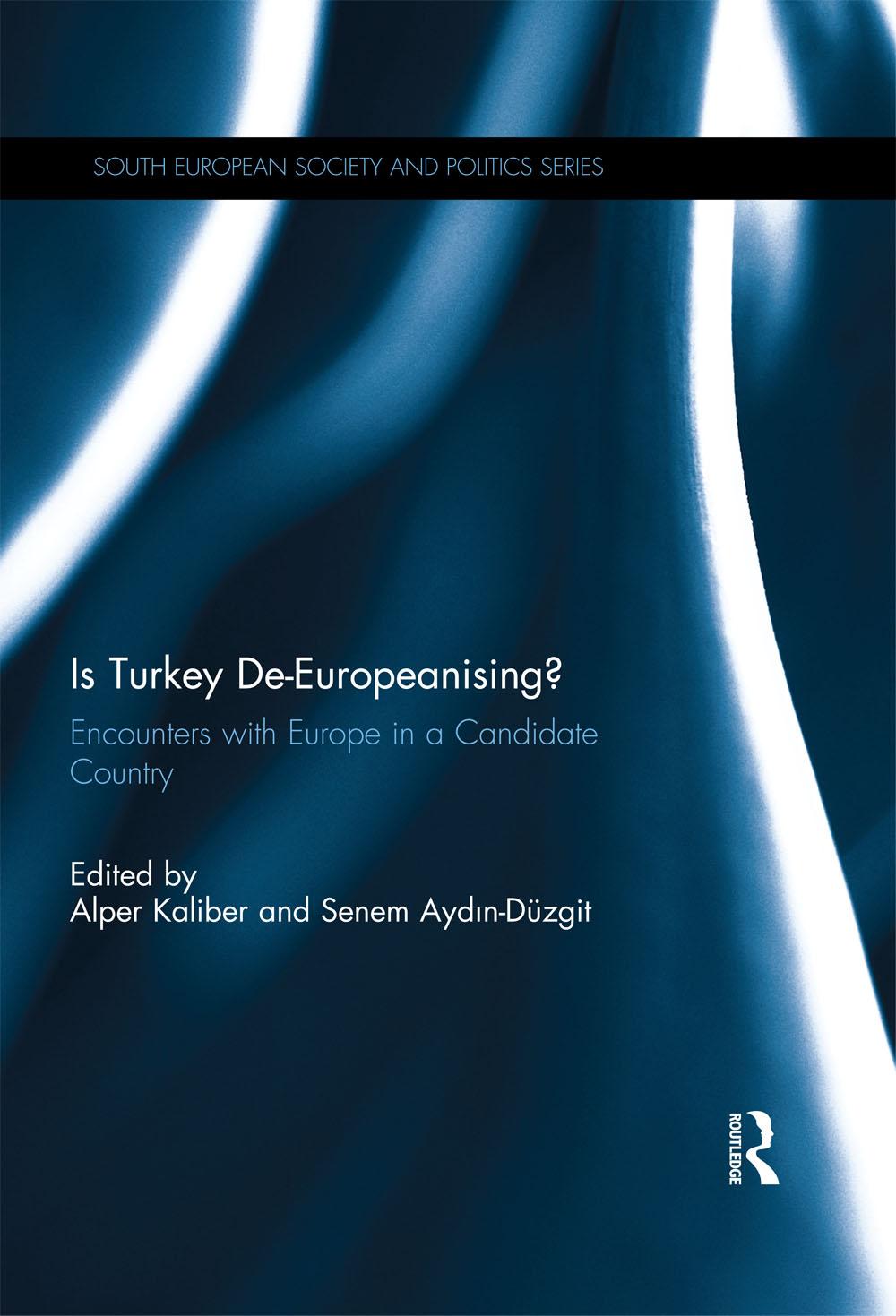
This comprehensive edited volume conceptually develops the notion of ‘de-Europeanisation’ as an important development in the literature on Europeanisation, and applies it specifically to the case of Turkey. ‘De-Europeanisation’ is defined as the loss or weakening of the EU/Europe as a normative/political context and as a reference point in domestic settings and national public debates of both candidate and member countries. ‘De-Europeanisation’ manifests itself in two basic ways: as the weakening of the appeal and influential capacity of European institutions, policies, norms and values, leading to a retreat of EU/ Europe as a normative/political context for society and politics in a candidate/member state; and as growing scepticism and indifference in a given society towards the EU/Europe, risking the legitimacy of the EU/Europe as a reference point in cases even where reform is incurred. Using this concept, the authors analyse the diminishing impact of the EU in Turkish governance and politics after the opening of accession negotiations in October 2005. The relevance of ‘de-Europeanisation’ is investigated through ten chapters focusing on key policy areas including education, migration, democracy, the rule of law and media freedoms, and a number of key actors including civil society organisations, political parties and political leaders.
This book was originally published as a special issue of South European Society and Politics.
Betala smidigt med kort, Klarna, Apple Pay eller Google Pay. Är du inte nöjd har du alltid 14 dagars ångerrätt. Läs mer i våra villkor. Har du några frågor, mejla oss på hello@memmo.org.
Memmo gör det enklare att plugga – var du än är i världen. Hos oss samlar du kursböcker och smarta studieverktyg på ett och samma ställe: sammanfattningar, quiz, poddar och flashcards. Och så Ted, din studiekompis som svarar på allt du undrar. Över 50 000 studenter pluggar redan här – byggt för att du ska lära dig snabbare och stressa mindre.