
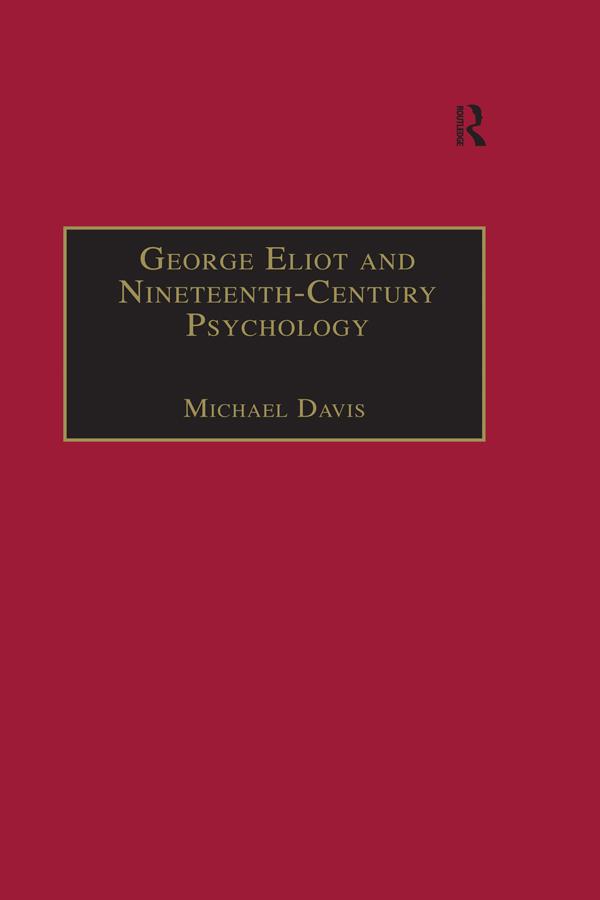
In his study of Eliot as a psychological novelist, Michael Davis examines Eliot's writings in the context of a large volume of nineteenth-century scientific writing about the mind. Eliot, Davis argues, manipulated scientific language in often subversive ways to propose a vision of mind as both fundamentally connected to the external world and radically isolated from and independent of that world. In showing the alignments between Eliot's work and the formulations of such key thinkers as Herbert Spencer, Charles Darwin, T. H. Huxley, and G. H. Lewes, Davis reveals how Eliot responds both creatively and critically to contemporary theories of mind, as she explores such fundamental issues as the mind/body relationship, the mind in evolutionary theory, the significance of reason and emotion, and consciousness. Davis also points to important parallels between Eliot's work and new and future developments in psychology, particularly in the work of William James. In Middlemarch, for example, Eliot demonstrates more clearly than either Lewes or James the way the conscious self is shaped by language. Davis concludes by showing that the complexity of mind, which Eliot expresses through her imaginative use of scientific language, takes on a potentially theological significance. His book suggests a new trajectory for scholars exploring George Eliot's representations of the self in the context of science, society, and religious faith.
Betala smidigt med kort, Klarna, Apple Pay eller Google Pay. Är du inte nöjd har du alltid 14 dagars ångerrätt. Läs mer i våra villkor. Har du några frågor, mejla oss på hello@memmo.org.
Memmo gör det enklare att plugga – var du än är i världen. Hos oss samlar du kursböcker och smarta studieverktyg på ett och samma ställe: sammanfattningar, quiz, poddar och flashcards. Och så Ted, din studiekompis som svarar på allt du undrar. Över 50 000 studenter pluggar redan här – byggt för att du ska lära dig snabbare och stressa mindre.
Du kanske också gillar
Köp boken0