
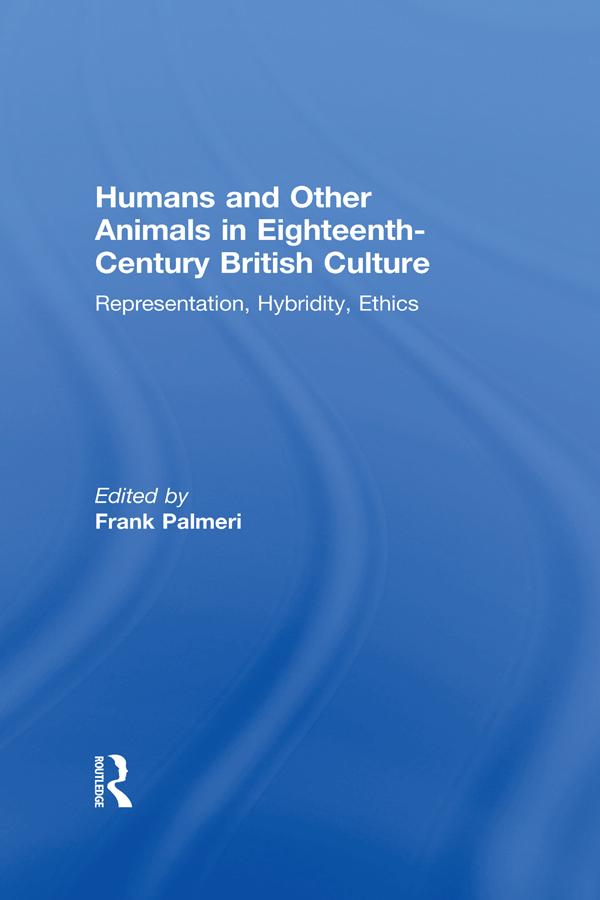
Combining historical and interpretive work, this collection examines changing perceptions of and relations between human and nonhuman animals in Britain over the long eighteenth century. Persistent questions concern modes of representing animals and animal-human hybrids, as well as the ethical issues raised by the human uses of other animals. From the animal men of Thomas Rowlandson to the part animal-part human creature of Victor Frankenstein, hybridity serves less as a metaphor than as a metonym for the intersections of humans and other animals. The contributors address such recurring questions as the implications of the Enlightenment project of naming and classifying animals, the equating of non-European races and nonhuman animals in early ethnographic texts, and the desire to distinguish the purely human from the entirely nonhuman animal. Gulliver's Travels and works by Mary and Percy Shelley emerge as key texts for this study. The volume will be of interest to scholars and students who work in animal, colonial, gender, and cultural studies; and will appeal to general readers concerned with the representation of animals and their treatment by humans.
Betala smidigt med kort, Klarna, Apple Pay eller Google Pay. Är du inte nöjd har du alltid 14 dagars ångerrätt. Läs mer i våra villkor. Har du några frågor, mejla oss på hello@memmo.org.
Memmo gör det enklare att plugga – var du än är i världen. Hos oss samlar du kursböcker och smarta studieverktyg på ett och samma ställe: sammanfattningar, quiz, poddar och flashcards. Och så Ted, din studiekompis som svarar på allt du undrar. Över 50 000 studenter pluggar redan här – byggt för att du ska lära dig snabbare och stressa mindre.
Du kanske också gillar
Köp boken0